SARS-CoV-2 viral shedding characteristics and potential evidence for the priority for faecal specimen testing in diagnosis yuan2021sars
This study investigates the shedding of SARS-CoV-2 RNA across multiple specimen types-including stool, respiratory secretions, urine, and serum-in both symptomatic and asymptomatic COVID-19 patients. It evaluates viral load dynamics and time to clearance across specimen types.
Analytes
nasopharyngeal_swab_SARSCoV2_ORF1ab_symptomatic
This entry describes RT-qPCR detection of SARS-CoV-2 RNA (Ct < 40 considered positive) targeting the ORF1ab gene in nasopharyngeal_swab from symptomatic individuals.
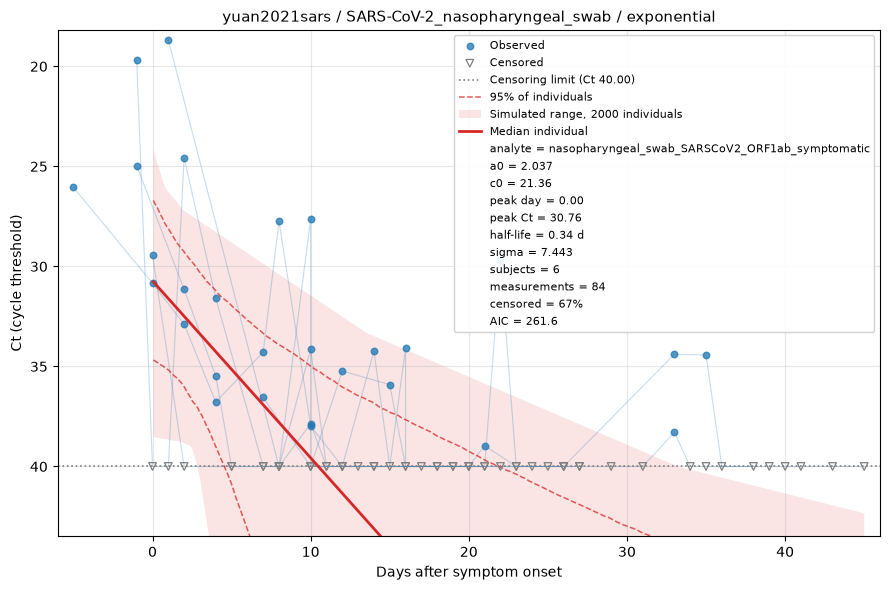
Fitted by censored maximum likelihood. The red line is the median individual; the shaded region is the full range of a simulated cohort drawn from the fitted population, so it shows what simulating from this dataset would produce rather than a confidence interval, with dashed lines at the central 95%. Open triangles are non-detects, drawn at the censoring limit and entering the fit as "below this value" rather than being dropped. See the modelling methods for what these estimates do and do not support.
nasopharyngeal_swab_SARSCoV2_ORF1ab_asymptomatic
This entry describes RT-qPCR detection of SARS-CoV-2 RNA (Ct < 40 considered positive) targeting the ORF1ab gene in nasopharyngeal_swab from asymptomatic individuals.
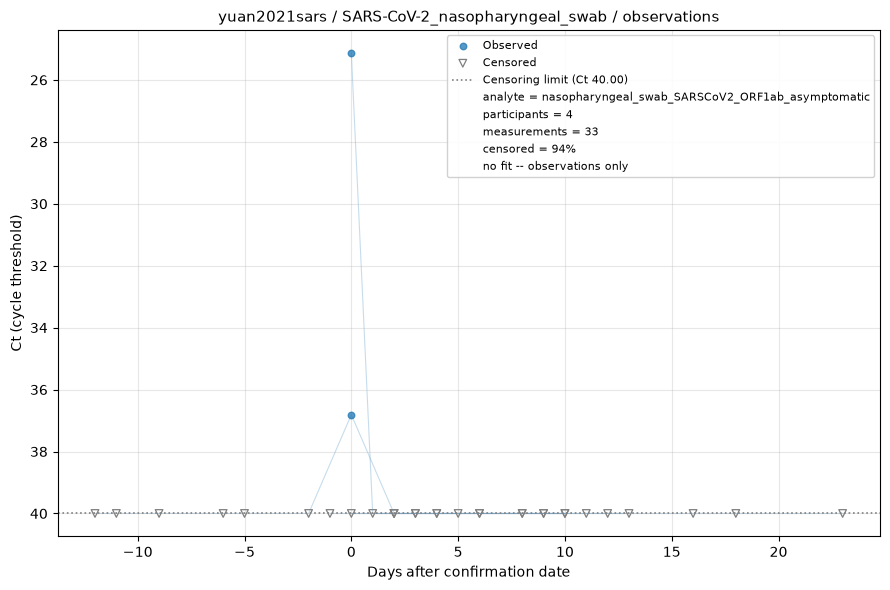
Measurements only — no shedding model is fitted to this analyte, usually because it is sampled once per participant, leaving no trajectory to fit, or because nothing was ever detected. Open triangles are non-detects, drawn at the assay's censoring limit. See the modelling methods for what these estimates do and do not support.
nasopharyngeal_swab_SARSCoV2_N_symptomatic
This entry describes RT-qPCR detection of SARS-CoV-2 RNA (Ct < 40 considered positive) targeting the N gene in nasopharyngeal_swab from symptomatic individuals.
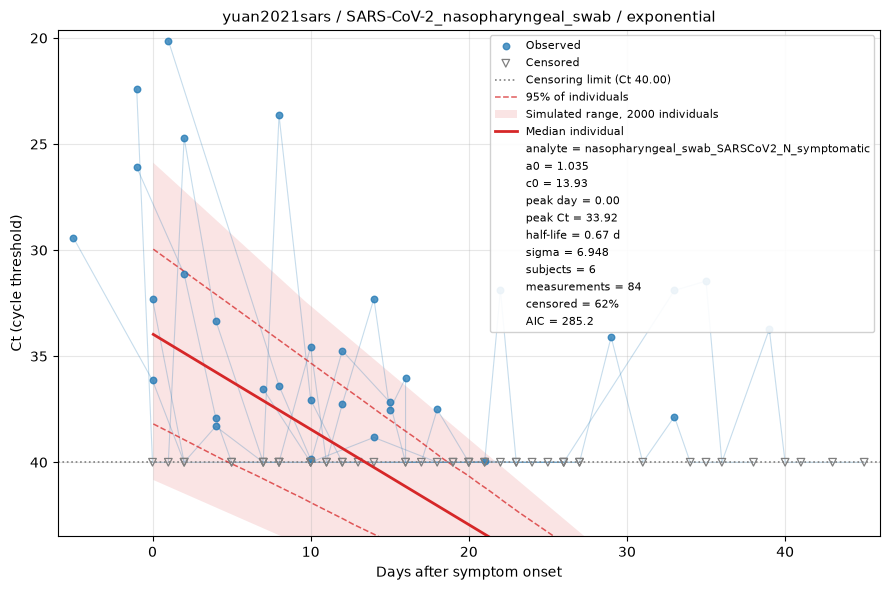
Fitted by censored maximum likelihood. The red line is the median individual; the shaded region is the full range of a simulated cohort drawn from the fitted population, so it shows what simulating from this dataset would produce rather than a confidence interval, with dashed lines at the central 95%. Open triangles are non-detects, drawn at the censoring limit and entering the fit as "below this value" rather than being dropped. See the modelling methods for what these estimates do and do not support.
nasopharyngeal_swab_SARSCoV2_N_asymptomatic
This entry describes RT-qPCR detection of SARS-CoV-2 RNA (Ct < 40 considered positive) targeting the N gene in nasopharyngeal_swab from asymptomatic individuals.
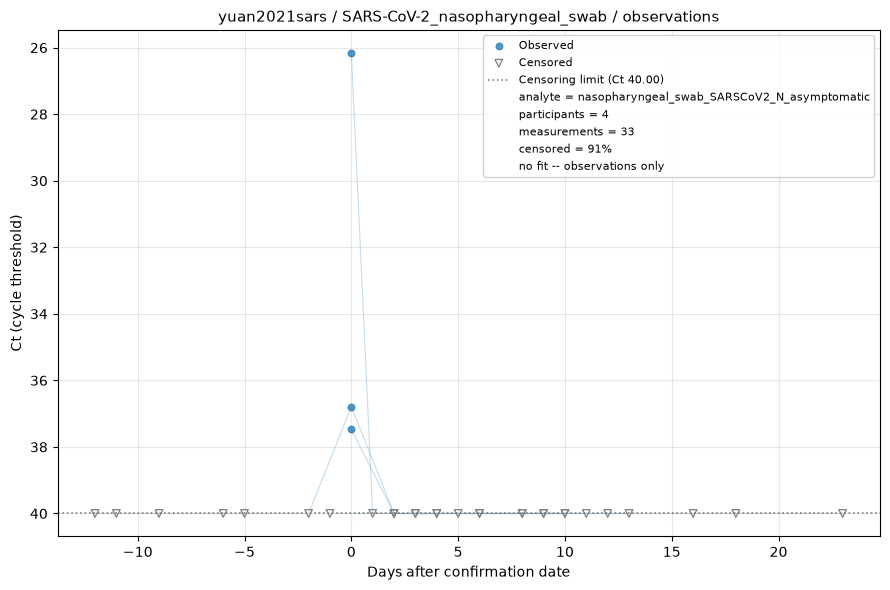
Measurements only — no shedding model is fitted to this analyte, usually because it is sampled once per participant, leaving no trajectory to fit, or because nothing was ever detected. Open triangles are non-detects, drawn at the assay's censoring limit. See the modelling methods for what these estimates do and do not support.
stool_SARSCoV2_ORF1ab_symptomatic
This entry describes RT-qPCR detection of SARS-CoV-2 RNA (Ct < 40 considered positive) targeting the ORF1ab gene in stool from symptomatic individuals.
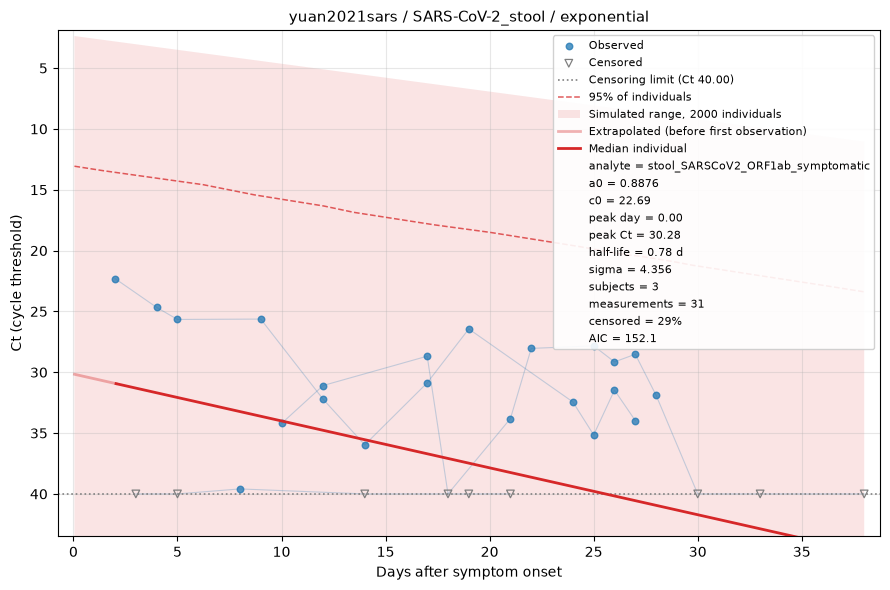
Fitted by censored maximum likelihood. The red line is the median individual; the shaded region is the full range of a simulated cohort drawn from the fitted population, so it shows what simulating from this dataset would produce rather than a confidence interval, with dashed lines at the central 95%. Open triangles are non-detects, drawn at the censoring limit and entering the fit as "below this value" rather than being dropped. See the modelling methods for what these estimates do and do not support.
stool_SARSCoV2_ORF1ab_asymptomatic
This entry describes RT-qPCR detection of SARS-CoV-2 RNA (Ct < 40 considered positive) targeting the ORF1ab gene in stool from asymptomatic individuals.
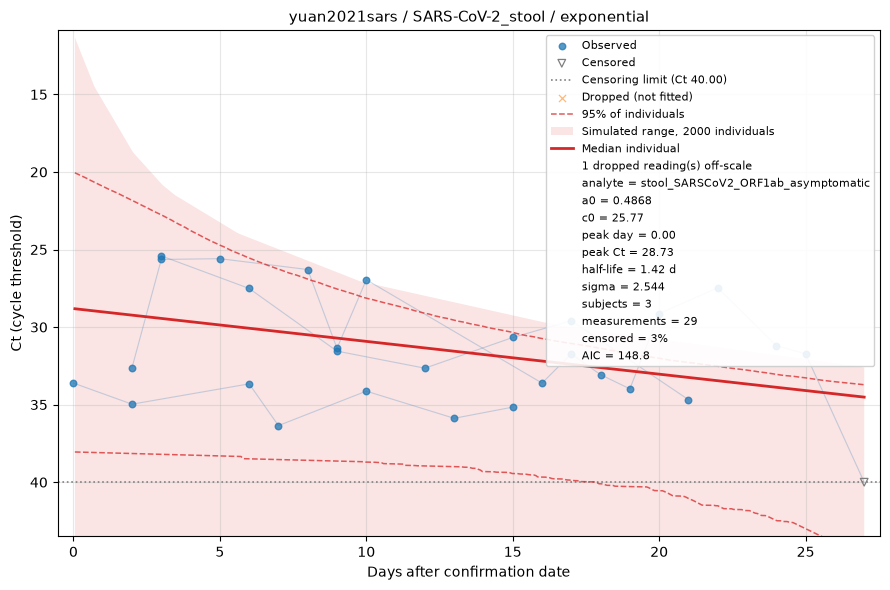
Fitted by censored maximum likelihood. The red line is the median individual; the shaded region is the full range of a simulated cohort drawn from the fitted population, so it shows what simulating from this dataset would produce rather than a confidence interval, with dashed lines at the central 95%. Open triangles are non-detects, drawn at the censoring limit and entering the fit as "below this value" rather than being dropped. See the modelling methods for what these estimates do and do not support.
stool_SARSCoV2_N_symptomatic
This entry describes RT-qPCR detection of SARS-CoV-2 RNA (Ct < 40 considered positive) targeting the N gene in stool from symptomatic individuals.
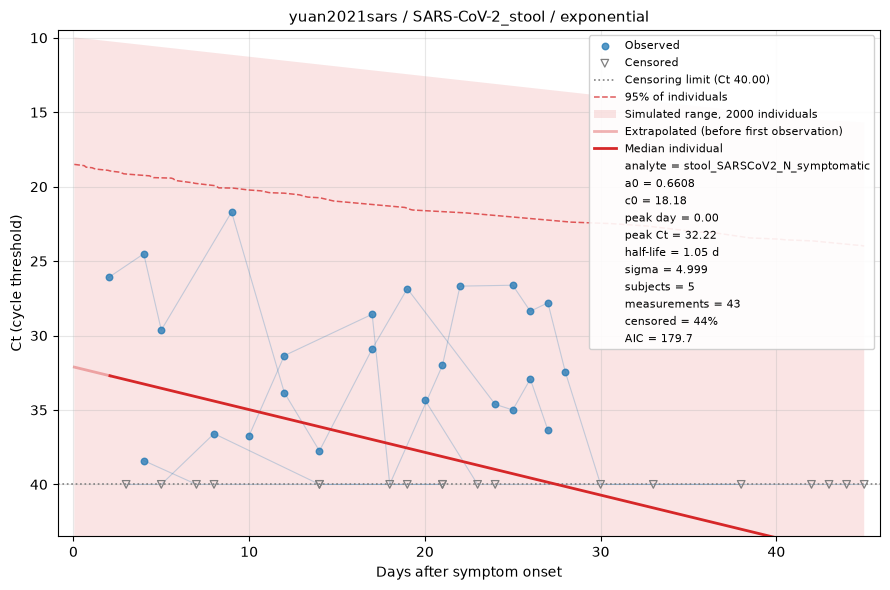
Fitted by censored maximum likelihood. The red line is the median individual; the shaded region is the full range of a simulated cohort drawn from the fitted population, so it shows what simulating from this dataset would produce rather than a confidence interval, with dashed lines at the central 95%. Open triangles are non-detects, drawn at the censoring limit and entering the fit as "below this value" rather than being dropped. See the modelling methods for what these estimates do and do not support.
stool_SARSCoV2_N_asymptomatic
This entry describes RT-qPCR detection of SARS-CoV-2 RNA (Ct < 40 considered positive) targeting the N gene in stool from asymptomatic individuals.
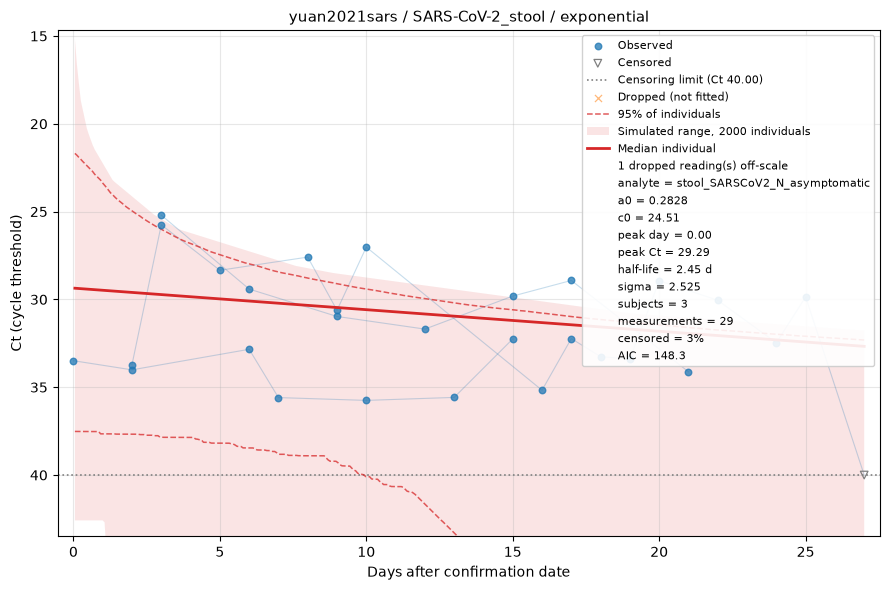
Fitted by censored maximum likelihood. The red line is the median individual; the shaded region is the full range of a simulated cohort drawn from the fitted population, so it shows what simulating from this dataset would produce rather than a confidence interval, with dashed lines at the central 95%. Open triangles are non-detects, drawn at the censoring limit and entering the fit as "below this value" rather than being dropped. See the modelling methods for what these estimates do and do not support.
serum_SARSCoV2_ORF1ab_symptomatic
This entry describes RT-qPCR detection of SARS-CoV-2 RNA (Ct < 40 considered positive) targeting the ORF1ab gene in serum from symptomatic individuals.
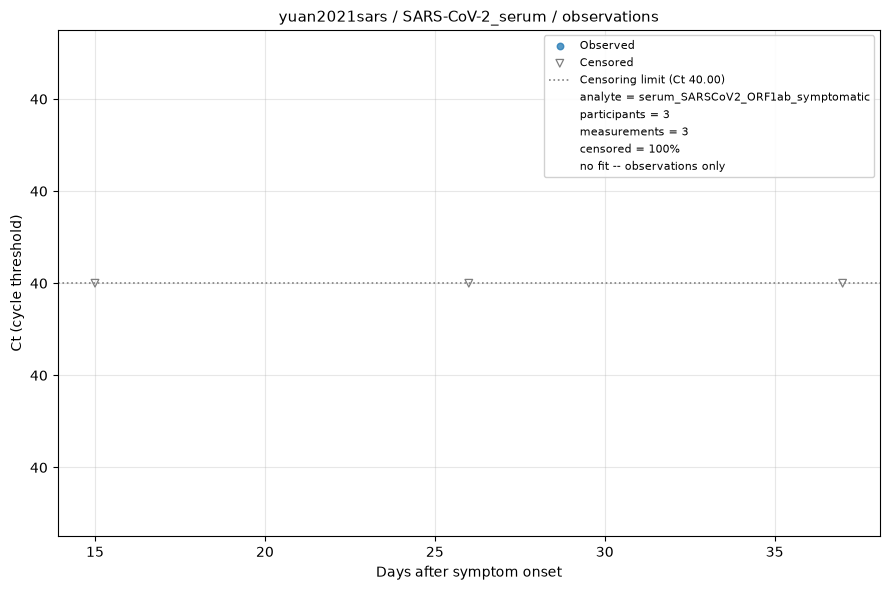
Measurements only — no shedding model is fitted to this analyte, usually because it is sampled once per participant, leaving no trajectory to fit, or because nothing was ever detected. Open triangles are non-detects, drawn at the assay's censoring limit. See the modelling methods for what these estimates do and do not support.
serum_SARSCoV2_ORF1ab_asymptomatic
This entry describes RT-qPCR detection of SARS-CoV-2 RNA (Ct < 40 considered positive) targeting the ORF1ab gene in serum from asymptomatic individuals.
Measurements only — no shedding model is fitted to this analyte, usually because it is sampled once per participant, leaving no trajectory to fit, or because nothing was ever detected. Open triangles are non-detects, drawn at the assay's censoring limit. See the modelling methods for what these estimates do and do not support.
serum_SARSCoV2_N_symptomatic
This entry describes RT-qPCR detection of SARS-CoV-2 RNA (Ct < 40 considered positive) targeting the N gene in serum from symptomatic individuals.
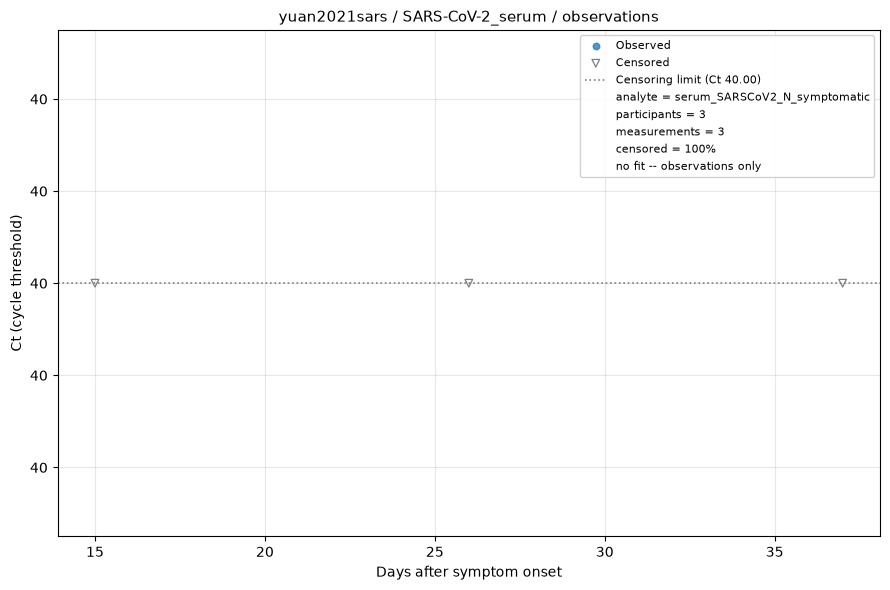
Measurements only — no shedding model is fitted to this analyte, usually because it is sampled once per participant, leaving no trajectory to fit, or because nothing was ever detected. Open triangles are non-detects, drawn at the assay's censoring limit. See the modelling methods for what these estimates do and do not support.
serum_SARSCoV2_N_asymptomatic
This entry describes RT-qPCR detection of SARS-CoV-2 RNA (Ct < 40 considered positive) targeting the N gene in serum from asymptomatic individuals.
Measurements only — no shedding model is fitted to this analyte, usually because it is sampled once per participant, leaving no trajectory to fit, or because nothing was ever detected. Open triangles are non-detects, drawn at the assay's censoring limit. See the modelling methods for what these estimates do and do not support.
urine_SARSCoV2_ORF1ab_symptomatic
This entry describes RT-qPCR detection of SARS-CoV-2 RNA (Ct < 40 considered positive) targeting the ORF1ab gene in urine from symptomatic individuals.
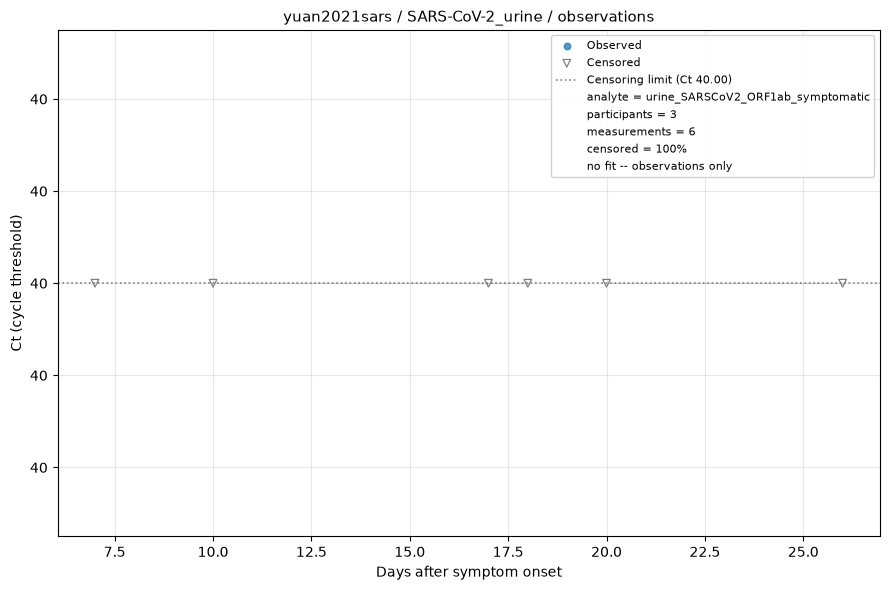
Measurements only — no shedding model is fitted to this analyte, usually because it is sampled once per participant, leaving no trajectory to fit, or because nothing was ever detected. Open triangles are non-detects, drawn at the assay's censoring limit. See the modelling methods for what these estimates do and do not support.
urine_SARSCoV2_ORF1ab_asymptomatic
This entry describes RT-qPCR detection of SARS-CoV-2 RNA (Ct < 40 considered positive) targeting the ORF1ab gene in urine from asymptomatic individuals.
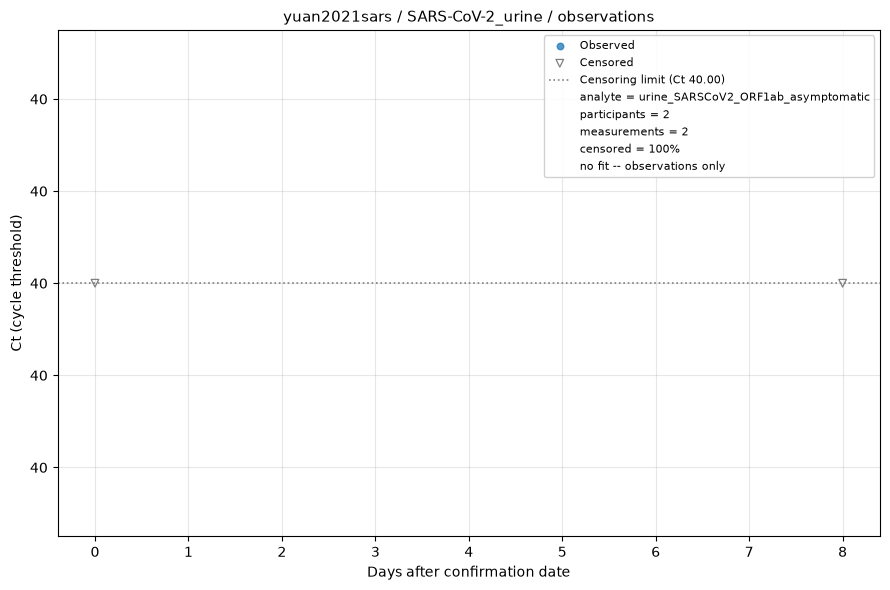
Measurements only — no shedding model is fitted to this analyte, usually because it is sampled once per participant, leaving no trajectory to fit, or because nothing was ever detected. Open triangles are non-detects, drawn at the assay's censoring limit. See the modelling methods for what these estimates do and do not support.
urine_SARSCoV2_N_symptomatic
This entry describes RT-qPCR detection of SARS-CoV-2 RNA (Ct < 40 considered positive) targeting the N gene in urine from symptomatic individuals.
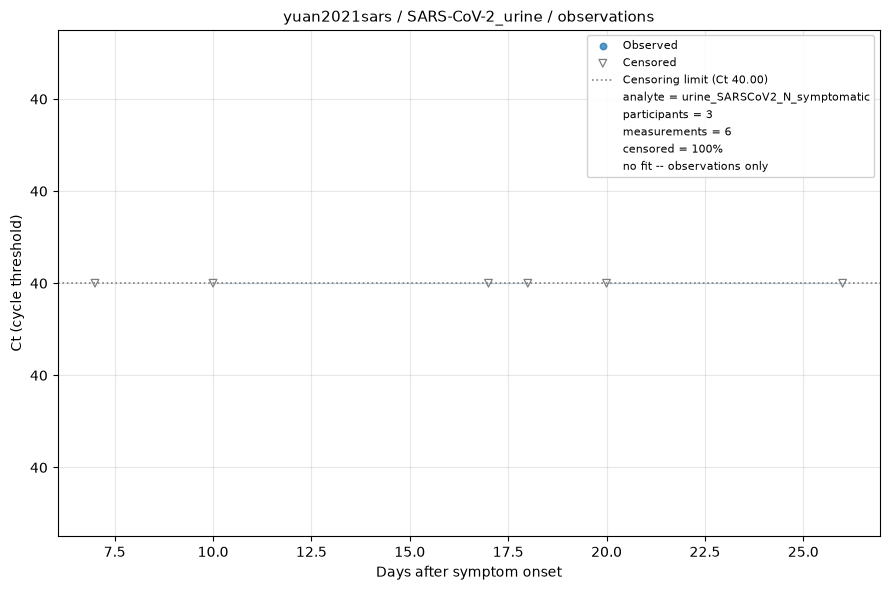
Measurements only — no shedding model is fitted to this analyte, usually because it is sampled once per participant, leaving no trajectory to fit, or because nothing was ever detected. Open triangles are non-detects, drawn at the assay's censoring limit. See the modelling methods for what these estimates do and do not support.
urine_SARSCoV2_N_asymptomatic
This entry describes RT-qPCR detection of SARS-CoV-2 RNA (Ct < 40 considered positive) targeting the N gene in urine from asymptomatic individuals.
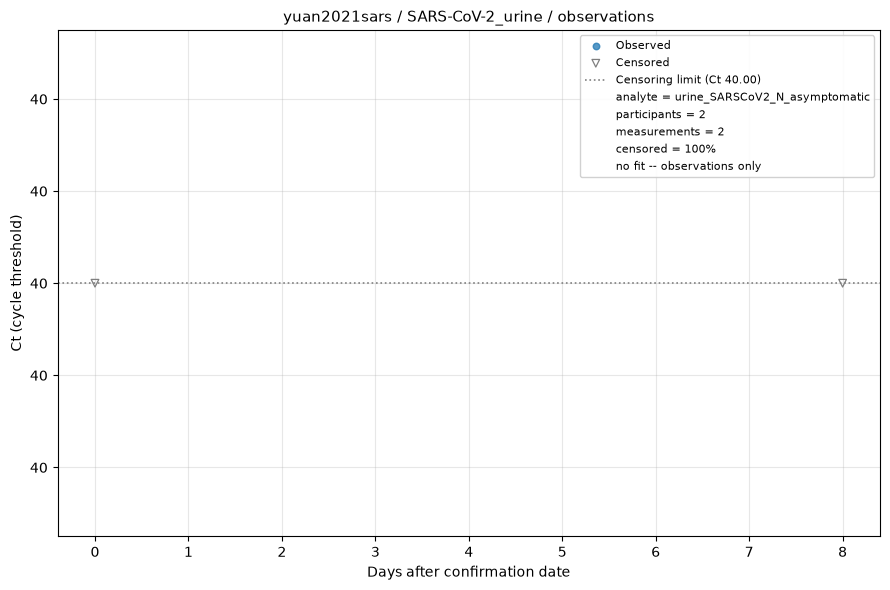
Measurements only — no shedding model is fitted to this analyte, usually because it is sampled once per participant, leaving no trajectory to fit, or because nothing was ever detected. Open triangles are non-detects, drawn at the assay's censoring limit. See the modelling methods for what these estimates do and do not support.