Detection of fecal shedding of rotavirus vaccine in infants following their first dose of pentavalent rotavirus vaccine yen2011detection
This study, conducted between May 2008 and February 2009 at the Broadway Practice of the Ambulatory Care Network of New York-Presbyterian Hospital, examined fecal shedding of the pentavalent rotavirus vaccine (RV5) in infants aged 6 to 12 weeks following their first dose. The study involved 198 enrolled infants, with 103 returning stool collection kits. Rotavirus antigen was detected in 21.4% of the kits. The study used enzyme immunoassay (EIA) and RT-PCR to detect vaccine-type rotavirus in stool samples collected over 9 days post-vaccination. The findings suggest potential for horizontal transmission of vaccine virus, particularly in households with immunocompromised individuals.
Analytes
stool_rotavirus_vaccine
Detection of rotavirus vaccine shedding in stool samples using enzyme immunoassay (EIA) and RT-PCR methods.
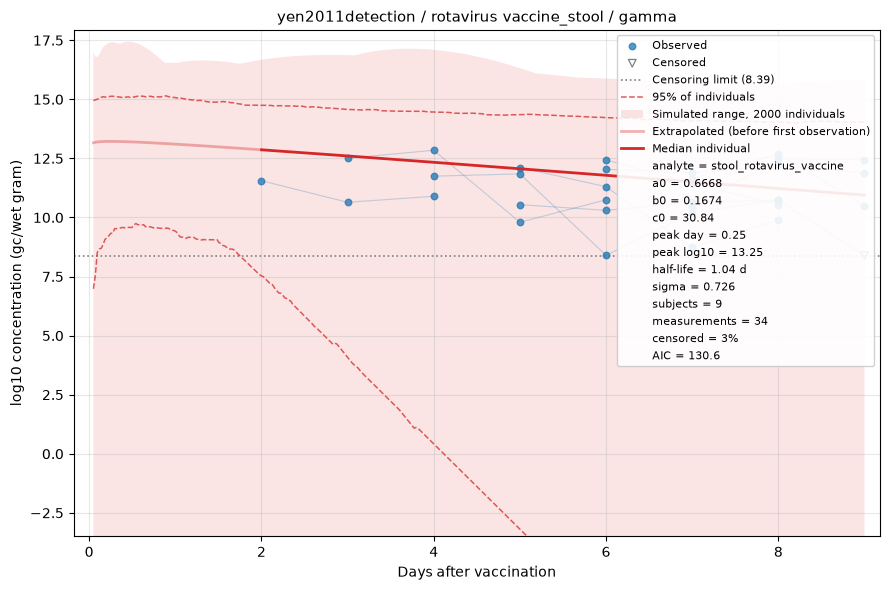
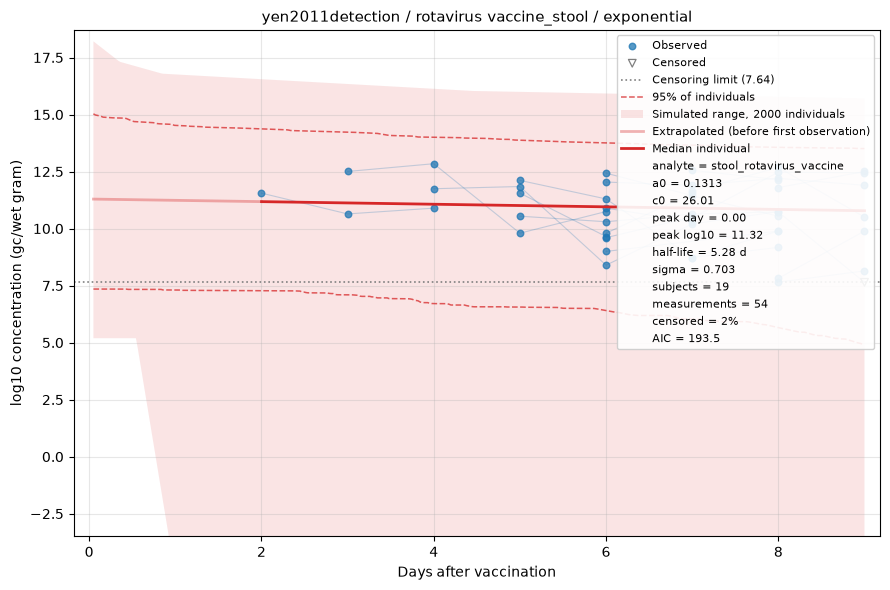
Fitted by censored maximum likelihood. The red line is the median individual; the shaded region is the full range of a simulated cohort drawn from the fitted population, so it shows what simulating from this dataset would produce rather than a confidence interval, with dashed lines at the central 95%. Open triangles are non-detects, drawn at the censoring limit and entering the fit as "below this value" rather than being dropped. See the modelling methods for what these estimates do and do not support.