High and persistent excretion of hepatitis A virus in immunocompetent patients tjon2006high
This study investigates the duration and level of hepatitis A virus (HAV) excretion in blood and feces of 27 patients with acute hepatitis A, with a median age of 33 years, over a period of up to 26 weeks. The study also includes single blood donations from 55 other patients with acute HAV, with a median age of 32 years. Virus loads were quantified using competitive nested RT-PCR. The study found that HAV was excreted in feces for a median period of 81 days after disease onset, with high levels of excretion in the first month. Viraemia was detected for a median period of 42 days. The study highlights the potential for prolonged infectiousness and the need for awareness in blood banks regarding viraemia persistence.
Analytes
stool_hepatitis_A_virus
Hepatitis A virus shedding in stool samples measured by competitive nested RT-PCR
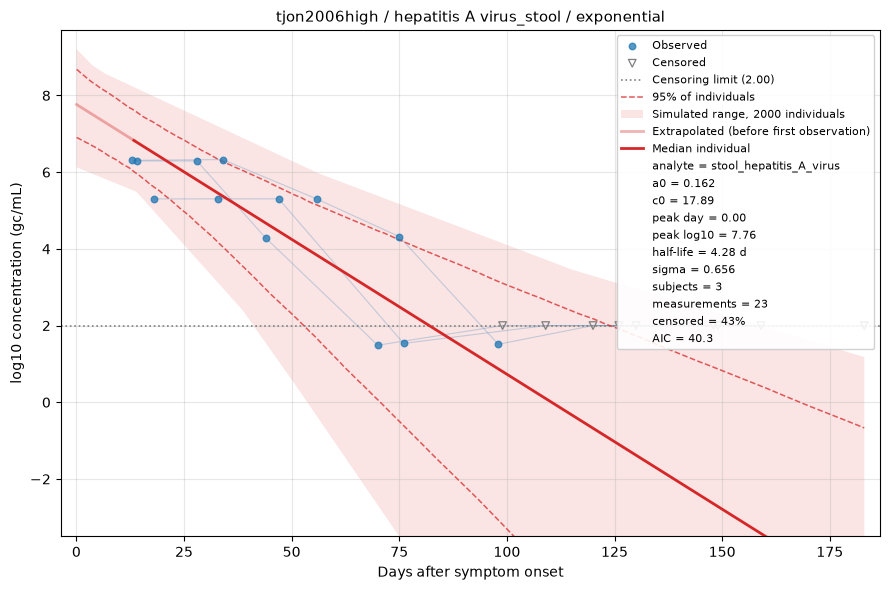
Fitted by censored maximum likelihood. The red line is the median individual; the shaded region is the full range of a simulated cohort drawn from the fitted population, so it shows what simulating from this dataset would produce rather than a confidence interval, with dashed lines at the central 95%. Open triangles are non-detects, drawn at the censoring limit and entering the fit as "below this value" rather than being dropped. See the modelling methods for what these estimates do and do not support.