Characterization of emerging GII.g/GII.12 noroviruses from a gastroenteritis outbreak in the United States in 2010 takanashi2011characterization
Study of a norovirus gastroenteritis outbreak in Ohio (January 2010). Stool and saliva samples were obtained from six infected individuals; two representative strains were sequenced and characterized as recombinant GII.g (polymerase)/GII.12 (capsid). Real-time RT-PCR was used to detect/quantify norovirus shedding; one immunocompetent 2-year-old male shed virus up to 30 days. HBGA typing was performed on saliva to assess host susceptibility patterns.
Analytes
stool_norovirus_gc_ml
Norovirus genome quantification in stool by real-time reverse transcription PCR (RT-qPCR), reported as genomic equivalents per mL.
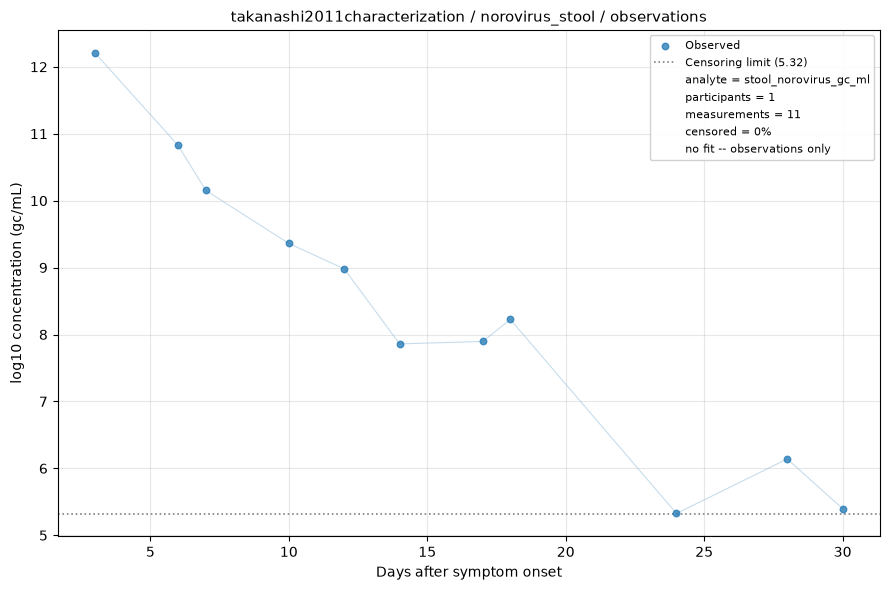
Measurements only — no shedding model is fitted to this analyte, usually because it is sampled once per participant, leaving no trajectory to fit, or because nothing was ever detected. Open triangles are non-detects, drawn at the assay's censoring limit. See the modelling methods for what these estimates do and do not support.