Influenza virus infection and aerosol shedding kinetics in a controlled human infection model shetty2024influenza
Controlled human infection study (Emory University Hospital, July–September 2022) in which eight adults were intranasally inoculated with influenza A/Perth/16/2009 (H3N2). Viral shedding was measured in nasopharyngeal swabs, saliva, nasal lavage fluid, stool, urine, exhaled breath aerosols, and environmental surface swabs. Six of eight participants became PCR-positive; infectious virus was measured by plaque assay (MDCK cells) in NP swabs, saliva, and nasal lavage fluid. Respiratory particle emissions were sampled during breathing and speaking and analyzed by ddPCR for viral RNA. Clinical symptom scores and serology (HAI, MN) were also collected.
Analytes
nasopharyngeal_swab_ct
Cycle threshold (Ct) values from clinical PCR testing of nasopharyngeal swabs (Xpert Xpress CoV-2/Flu/RSV plus assay; two influenza primer sets). Ct values were obtained from the clinical laboratory.
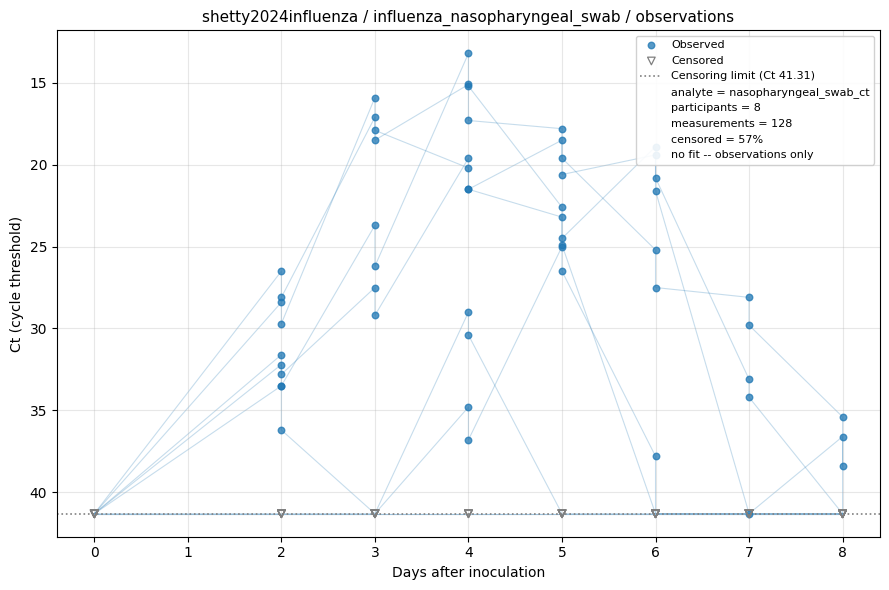
Measurements only — no shedding model is fitted to this analyte, usually because it is sampled once per participant, leaving no trajectory to fit, or because nothing was ever detected. Open triangles are non-detects, drawn at the assay's censoring limit. See the modelling methods for what these estimates do and do not support.
nasopharyngeal_swab_pfu_ml
Infectious virus titer measured by plaque assay on MDCK cells from nasopharyngeal swab specimens (plaque forming units per milliliter).
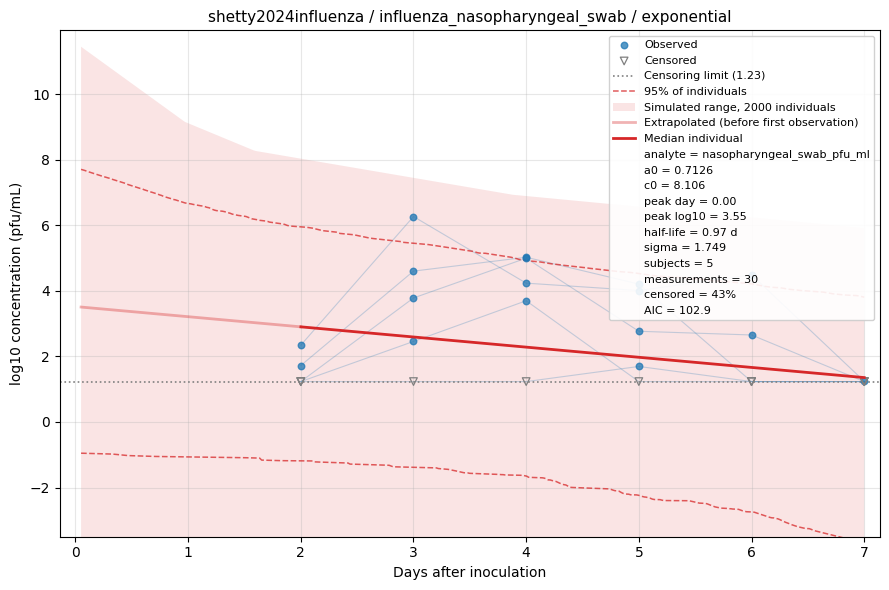
Fitted by censored maximum likelihood. The red line is the median individual; the shaded region is the full range of a simulated cohort drawn from the fitted population, so it shows what simulating from this dataset would produce rather than a confidence interval, with dashed lines at the central 95%. Open triangles are non-detects, drawn at the censoring limit and entering the fit as "below this value" rather than being dropped. See the modelling methods for what these estimates do and do not support.
saliva_pfu_ml
Infectious virus titer measured by plaque assay on MDCK cells from saliva specimens (plaque forming units per milliliter).
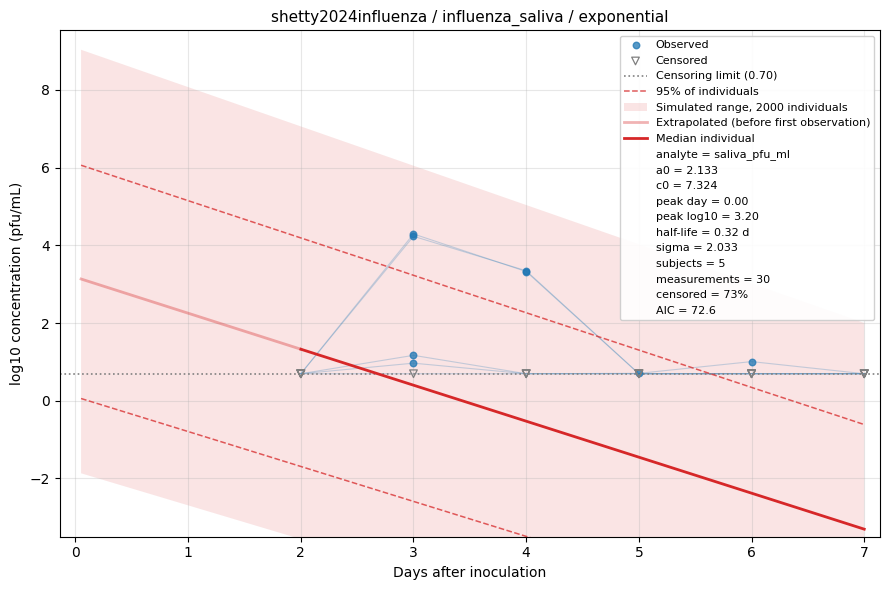
Fitted by censored maximum likelihood. The red line is the median individual; the shaded region is the full range of a simulated cohort drawn from the fitted population, so it shows what simulating from this dataset would produce rather than a confidence interval, with dashed lines at the central 95%. Open triangles are non-detects, drawn at the censoring limit and entering the fit as "below this value" rather than being dropped. See the modelling methods for what these estimates do and do not support.
nasal_lavage_fluid_pfu_ml
Infectious virus titer measured by plaque assay on MDCK cells from nasal lavage fluid specimens (plaque forming units per milliliter).
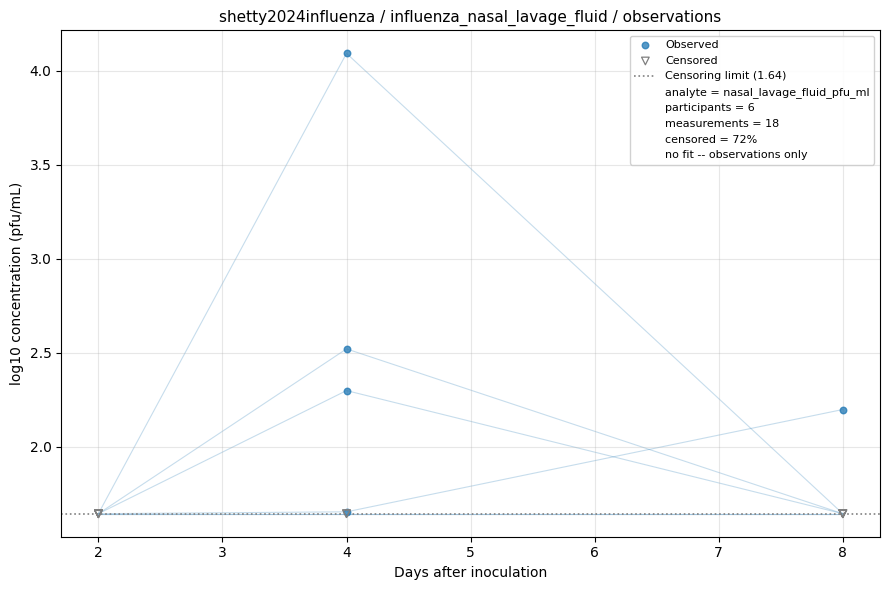
Measurements only — no shedding model is fitted to this analyte, usually because it is sampled once per participant, leaving no trajectory to fit, or because nothing was ever detected. Open triangles are non-detects, drawn at the assay's censoring limit. See the modelling methods for what these estimates do and do not support.