Detection and pathogenicity of human metapneumovirus respiratory infection in pediatric Italian patients during a winter–spring season sarasini2006detection
Prospective pediatric respiratory virus surveillance study in Pavia, Italy (winter–spring 2003–2004). Nasopharyngeal aspirates (NPA) from 306 infants/young children with acute respiratory infection were tested for respiratory viruses; human metapneumovirus (hMPV) was detected by RT-PCR. Serial NPA sampling in some hMPV-positive children was used to relate hMPV RNA load to clinical course and estimate duration of excretion. The extracted quantitative time series here come from a CSV derived from Table 3, reporting hMPV RNA copies/mL over follow-up (time in days from first/earliest NPA collection for each patient).
Analytes
nasopharyngeal_aspirate_metapneumovirus_rna_gc_ml
Human metapneumovirus (hMPV) RNA semiquantitation in nasopharyngeal aspirate (NPA) samples by RT-PCR, reported as RNA copies/mL (CSV values correspond to antilogged log10 RNA copies/mL from Table 3; negatives/undetectable recorded as negative). RT-PCR assays were optimized to detect at least 10 input plasmid copies; nucleic acids extracted with Nuclisens Iso Kit; products examined on agarose gel. hMPV detection used L gene primers for types A and B plus confirmation/amplification of N gene fragment (Table 1).
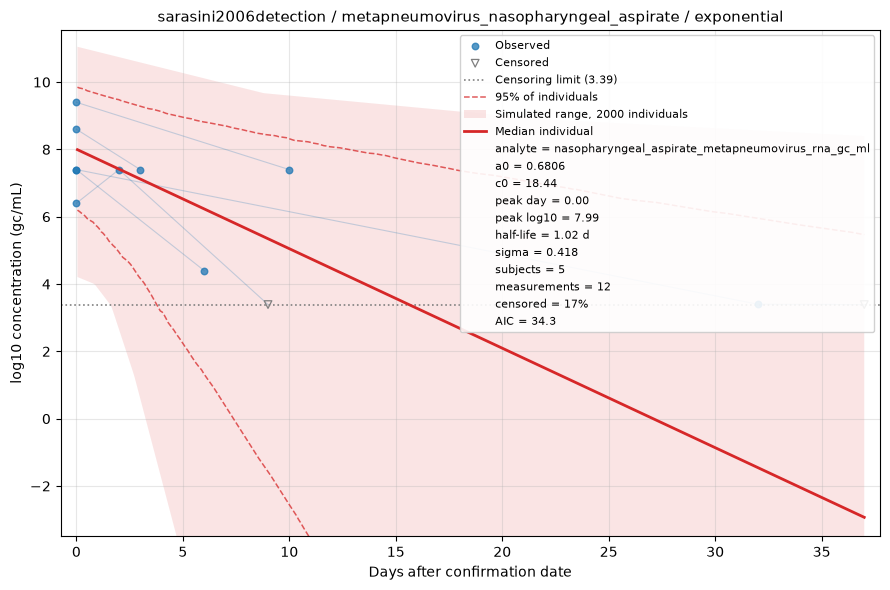
Fitted by censored maximum likelihood. The red line is the median individual; the shaded region is the full range of a simulated cohort drawn from the fitted population, so it shows what simulating from this dataset would produce rather than a confidence interval, with dashed lines at the central 95%. Open triangles are non-detects, drawn at the censoring limit and entering the fit as "below this value" rather than being dropped. See the modelling methods for what these estimates do and do not support.