Influenza A(H1N1)pdm09 infection and viral load analysis in patients with different clinical presentations rodrigues2020influenza
Study of H1N1pdm09 viral load (VL) in respiratory samples collected 2009-2013 at a tertiary hospital in São Paulo, Brazil. Samples from asymptomatic (AS), symptomatic outpatients (OP) and hospitalised patients (HP) were tested by quantitative one-step real-time RT-PCR targeting the M gene; VL reported as Log10 RNA copies/mL in the paper. A subset of 10 hospitalised patients treated with oseltamivir were followed longitudinally and serial VL measurements (days of treatment) are provided (Fig.2 / CSV).
Analytes
respiratory_influenza_viral_load
Quantitative one-step real-time RT-PCR targeting the influenza M gene. Human RNaseP was used as internal control and Ct values were normalised; viral load expressed as RNA copies per mL (paper reports Log10 RNA copies/mL; CSV measurements are linear copies/mL). Respiratory specimens included nasopharyngeal aspirates (children <2 years) and nasal/oropharyngeal swabs for other patients. Serial measurements in the CSV correspond to days of oseltamivir treatment (Fig.2).
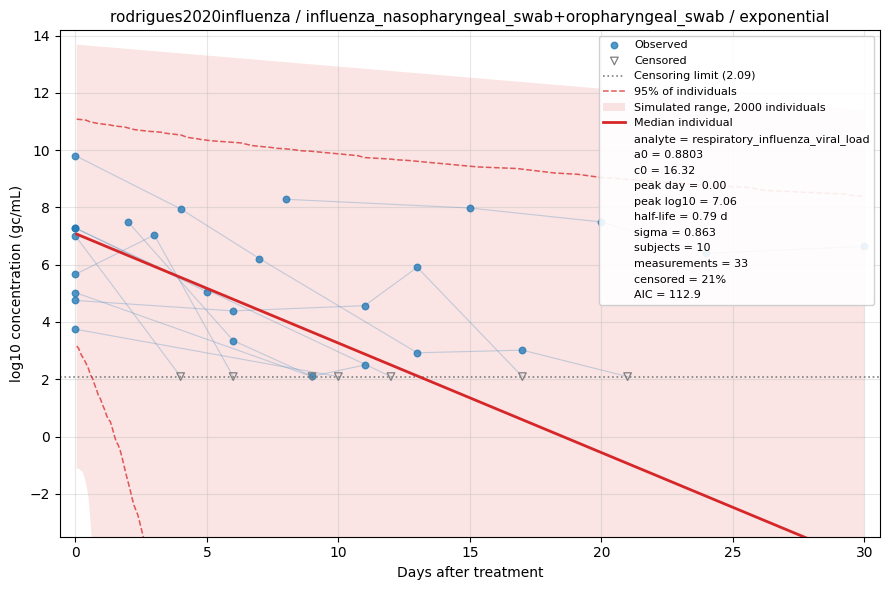
Fitted by censored maximum likelihood. The red line is the median individual; the shaded region is the full range of a simulated cohort drawn from the fitted population, so it shows what simulating from this dataset would produce rather than a confidence interval, with dashed lines at the central 95%. Open triangles are non-detects, drawn at the censoring limit and entering the fit as "below this value" rather than being dropped. See the modelling methods for what these estimates do and do not support.