Frequent detection of monkeypox virus DNA in saliva, semen, and other clinical samples from 12 patients, Barcelona, Spain, May to June 2022 peiromestres2022frequent
Observational shedding study of 12 confirmed symptomatic mpox (monkeypox virus) patients in Barcelona, Spain (May–June 2022). Multiple specimen types (skin lesion swab, saliva, rectal swab, nasopharyngeal swab, semen, urine, and faeces/stool) were tested at diagnosis and follow-up time points using real-time PCR, reporting Ct (Cq) values (or negative/NA). Timing is reported as days since symptom onset.
Analytes
ct_skin_lesion_swab
Monkeypox virus DNA detection by specific real-time PCR (qPCR) reported as quantification cycle (Cq/Ct). Clinical samples were inactivated 1:1 with cobas omni lysis reagent (Roche) prior to nucleic acid extraction (MagNA Pure Compact; MagNA Pure Compact Nucleic Acid Isolation Kit I—Large Volume). Initial diagnosis used an orthopox generic PCR plus a specific MPX PCR; follow-up samples tested with the specific MPX PCR assay. This analyte corresponds to skin lesion swab specimens.
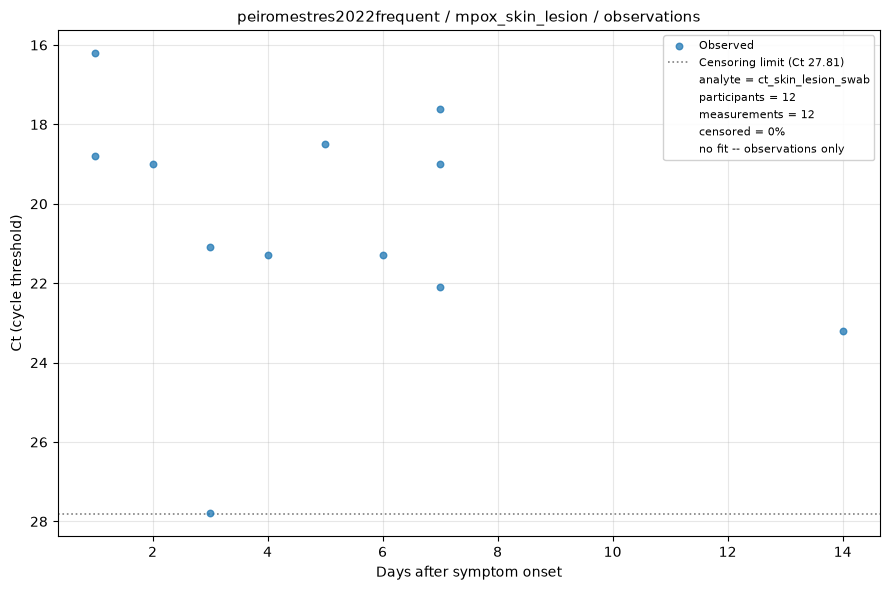
Measurements only — no shedding model is fitted to this analyte, usually because it is sampled once per participant, leaving no trajectory to fit, or because nothing was ever detected. Open triangles are non-detects, drawn at the assay's censoring limit. See the modelling methods for what these estimates do and do not support.
ct_rectal_swab
Monkeypox virus DNA detection by specific real-time PCR (qPCR) reported as quantification cycle (Cq/Ct). Samples were inactivated 1:1 with cobas omni lysis reagent (Roche) and extracted on MagNA Pure Compact. Initial diagnosis used orthopox generic PCR plus specific MPX PCR; follow-up used specific MPX PCR. This analyte corresponds to rectal swab specimens.
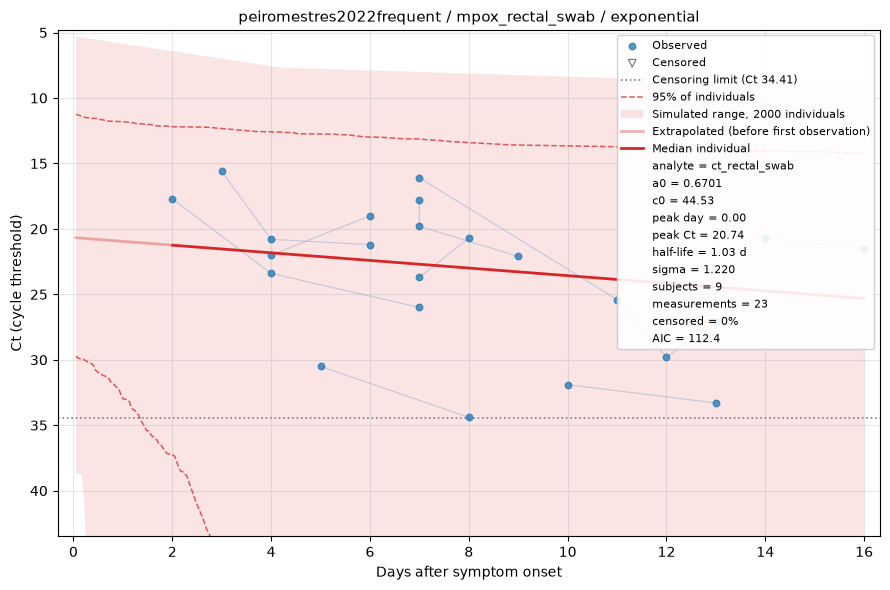
Fitted by censored maximum likelihood. The red line is the median individual; the shaded region is the full range of a simulated cohort drawn from the fitted population, so it shows what simulating from this dataset would produce rather than a confidence interval, with dashed lines at the central 95%. Open triangles are non-detects, drawn at the censoring limit and entering the fit as "below this value" rather than being dropped. See the modelling methods for what these estimates do and do not support.
ct_tongue_ulcer
Monkeypox virus DNA detection by specific real-time PCR (qPCR) reported as quantification cycle (Cq/Ct) from a tongue ulcer lesion swab (mucosal lesion). Samples were inactivated 1:1 with cobas omni lysis reagent (Roche) and extracted on MagNA Pure Compact. Initial diagnosis used orthopox generic PCR plus specific MPX PCR; follow-up used specific MPX PCR.
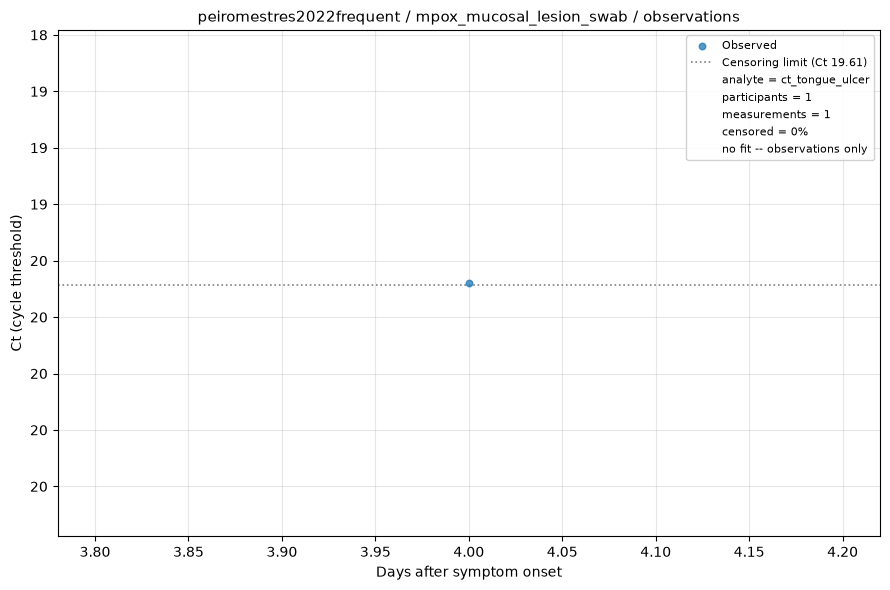
Measurements only — no shedding model is fitted to this analyte, usually because it is sampled once per participant, leaving no trajectory to fit, or because nothing was ever detected. Open triangles are non-detects, drawn at the assay's censoring limit. See the modelling methods for what these estimates do and do not support.
ct_oral_lesion
Monkeypox virus DNA detection by specific real-time PCR (qPCR) reported as quantification cycle (Cq/Ct) from an oral lesion swab (mucosal lesion). Samples were inactivated 1:1 with cobas omni lysis reagent (Roche) and extracted on MagNA Pure Compact. Initial diagnosis used orthopox generic PCR plus specific MPX PCR; follow-up used specific MPX PCR.
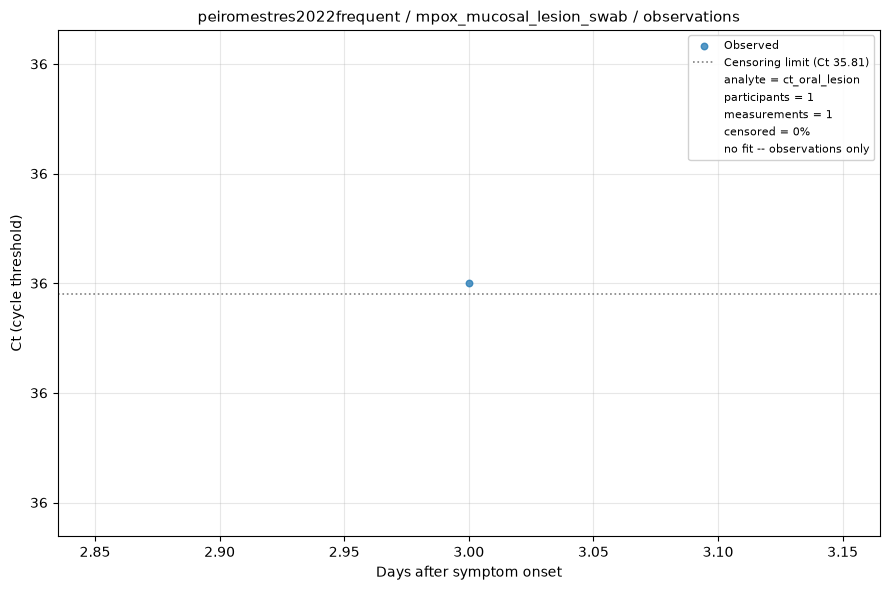
Measurements only — no shedding model is fitted to this analyte, usually because it is sampled once per participant, leaving no trajectory to fit, or because nothing was ever detected. Open triangles are non-detects, drawn at the assay's censoring limit. See the modelling methods for what these estimates do and do not support.
ct_saliva
Monkeypox virus DNA detection by specific real-time PCR (qPCR) reported as quantification cycle (Cq/Ct) from saliva. Samples were inactivated 1:1 with cobas omni lysis reagent (Roche) and extracted on MagNA Pure Compact. Initial diagnosis used orthopox generic PCR plus specific MPX PCR; follow-up used specific MPX PCR.
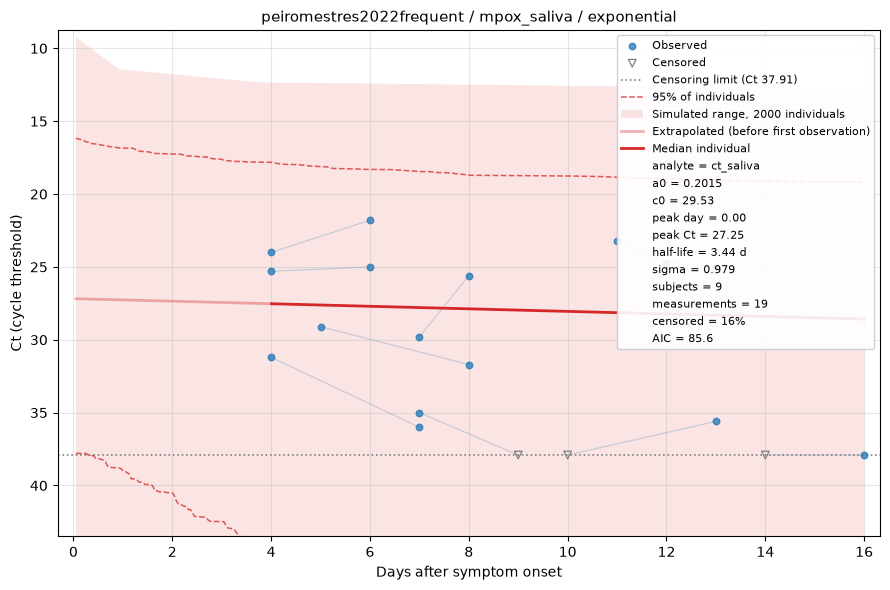
Fitted by censored maximum likelihood. The red line is the median individual; the shaded region is the full range of a simulated cohort drawn from the fitted population, so it shows what simulating from this dataset would produce rather than a confidence interval, with dashed lines at the central 95%. Open triangles are non-detects, drawn at the censoring limit and entering the fit as "below this value" rather than being dropped. See the modelling methods for what these estimates do and do not support.
ct_nasopharyngeal_swab
Monkeypox virus DNA detection by specific real-time PCR (qPCR) reported as quantification cycle (Cq/Ct) from nasopharyngeal swab. Samples were inactivated 1:1 with cobas omni lysis reagent (Roche) and extracted on MagNA Pure Compact. Initial diagnosis used orthopox generic PCR plus specific MPX PCR; follow-up used specific MPX PCR.
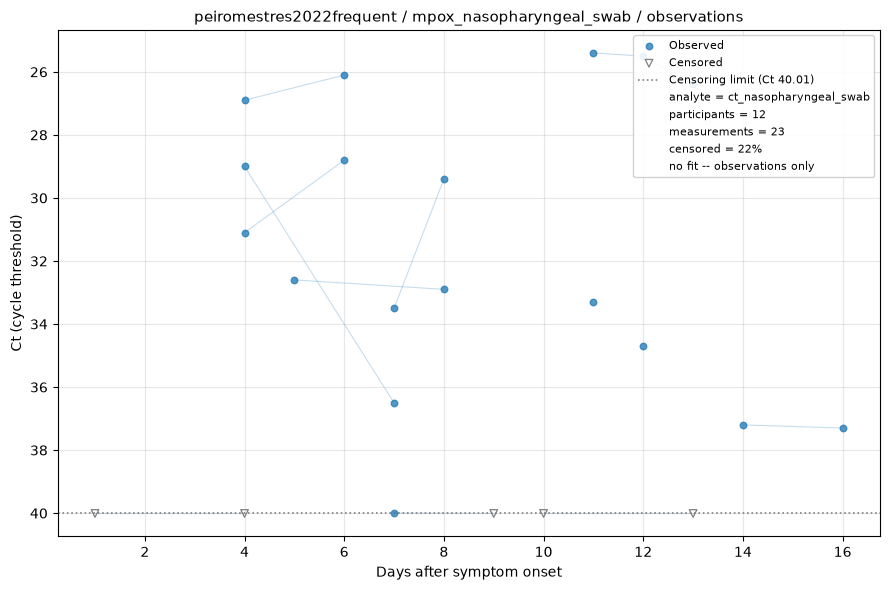
Measurements only — no shedding model is fitted to this analyte, usually because it is sampled once per participant, leaving no trajectory to fit, or because nothing was ever detected. Open triangles are non-detects, drawn at the assay's censoring limit. See the modelling methods for what these estimates do and do not support.
ct_semen
Monkeypox virus DNA detection by specific real-time PCR (qPCR) reported as quantification cycle (Cq/Ct) from semen. Samples were inactivated 1:1 with cobas omni lysis reagent (Roche) and extracted on MagNA Pure Compact. Initial diagnosis used orthopox generic PCR plus specific MPX PCR; follow-up used specific MPX PCR.
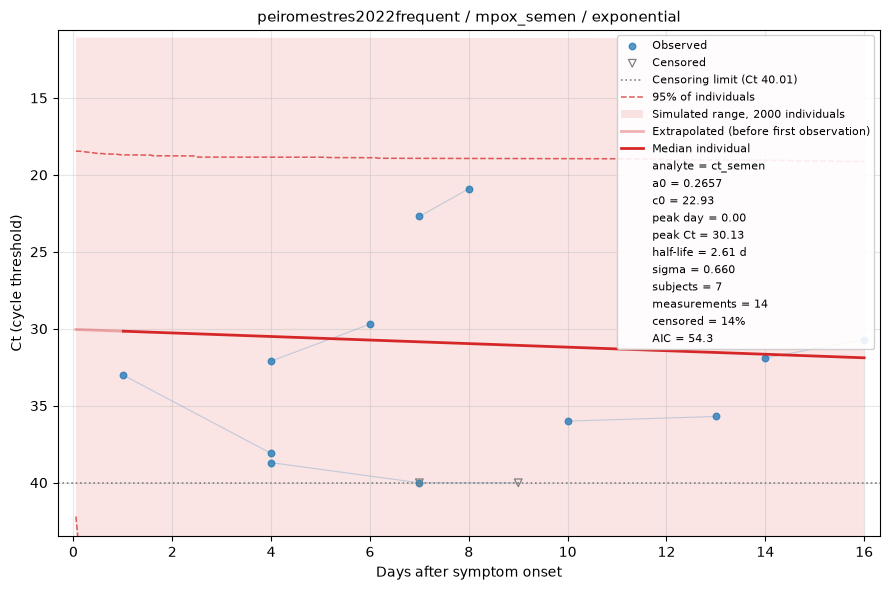
Fitted by censored maximum likelihood. The red line is the median individual; the shaded region is the full range of a simulated cohort drawn from the fitted population, so it shows what simulating from this dataset would produce rather than a confidence interval, with dashed lines at the central 95%. Open triangles are non-detects, drawn at the censoring limit and entering the fit as "below this value" rather than being dropped. See the modelling methods for what these estimates do and do not support.
ct_urine
Monkeypox virus DNA detection by specific real-time PCR (qPCR) reported as quantification cycle (Cq/Ct) from urine. Samples were inactivated 1:1 with cobas omni lysis reagent (Roche) and extracted on MagNA Pure Compact. Initial diagnosis used orthopox generic PCR plus specific MPX PCR; follow-up used specific MPX PCR.
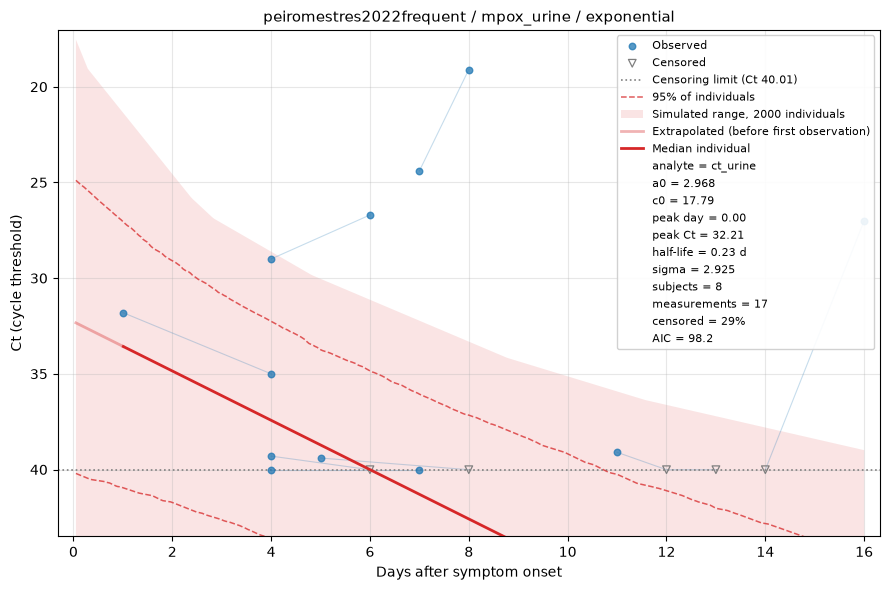
Fitted by censored maximum likelihood. The red line is the median individual; the shaded region is the full range of a simulated cohort drawn from the fitted population, so it shows what simulating from this dataset would produce rather than a confidence interval, with dashed lines at the central 95%. Open triangles are non-detects, drawn at the censoring limit and entering the fit as "below this value" rather than being dropped. See the modelling methods for what these estimates do and do not support.
ct_stool
Monkeypox virus DNA detection by specific real-time PCR (qPCR) reported as quantification cycle (Cq/Ct) from faeces (stool). Stool samples were processed as previously described by the authors (details not provided in the excerpt). Samples were inactivated 1:1 with cobas omni lysis reagent (Roche) and extracted on MagNA Pure Compact. Initial diagnosis used orthopox generic PCR plus specific MPX PCR; follow-up used specific MPX PCR.
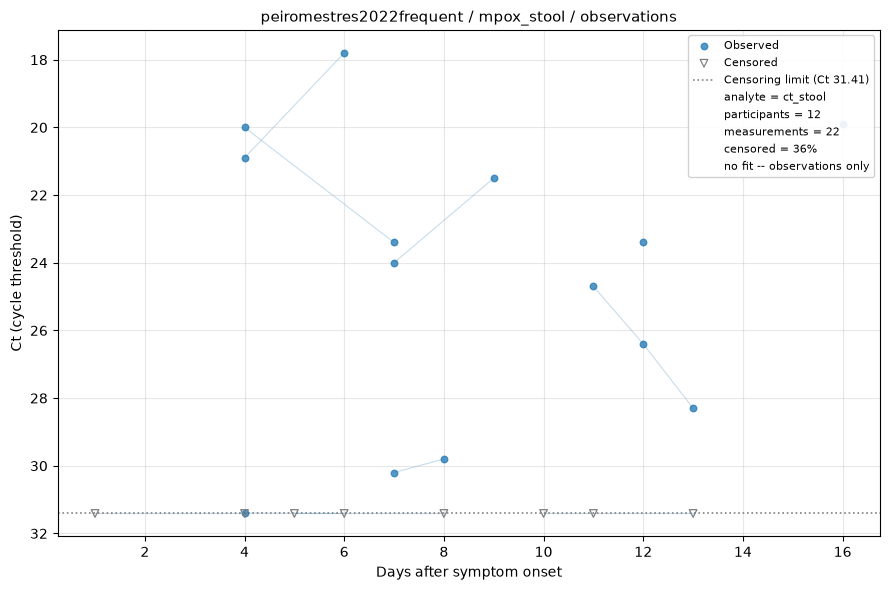
Measurements only — no shedding model is fitted to this analyte, usually because it is sampled once per participant, leaving no trajectory to fit, or because nothing was ever detected. Open triangles are non-detects, drawn at the assay's censoring limit. See the modelling methods for what these estimates do and do not support.