Single base substitutions in the capsid region of the norovirus genome during viral shedding in cases of infection in areas where norovirus infection is endemic obara2008single
This study investigates norovirus (NoV) infections in Toyama Prefecture, Japan, during fiscal year 2006, focusing on viral shedding in feces. The study involved 30 individuals from a local hotel outbreak in May 2006, with stool specimens collected and analyzed using real-time PCR. Two employees exhibited long-term viral shedding, with single base substitutions in the NoV capsid region observed. The study highlights the potential for NoV evolution in the gastrointestinal tract, with genetic changes occurring during the infectious course. The research was supported by a Health Labor Sciences Research Grant from the Japanese Ministry of Health, Labor, and Welfare.
Analytes
stool_norovirus
Real-time PCR assay for detecting norovirus GII in stool specimens, measuring the log10 copy number of NoVs per gram of feces.
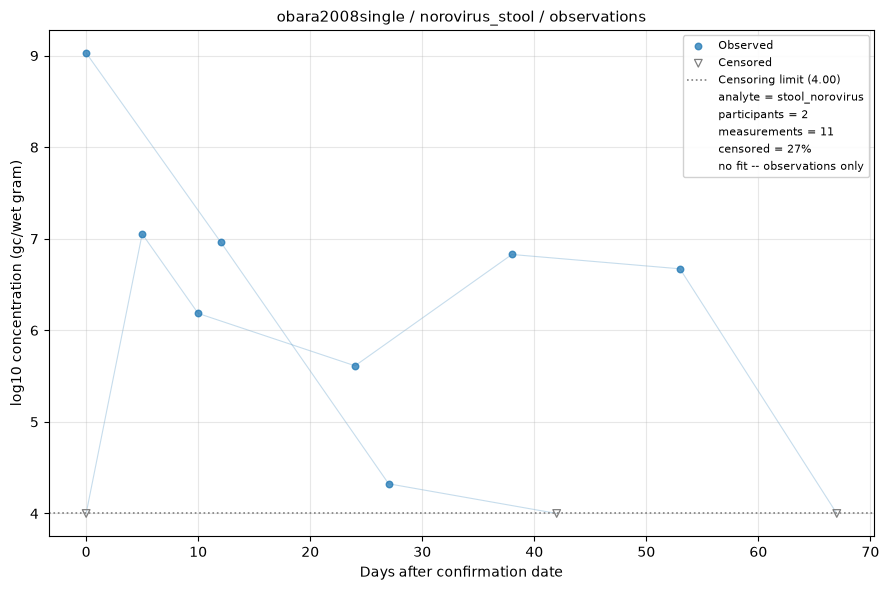
Measurements only — no shedding model is fitted to this analyte, usually because it is sampled once per participant, leaving no trajectory to fit, or because nothing was ever detected. Open triangles are non-detects, drawn at the assay's censoring limit. See the modelling methods for what these estimates do and do not support.