Sapovirus detection and quantification in fecal samples from allogeneic hematopoietic stem cell transplant recipients neres2020sapovirus
Longitudinal retrospective monitoring study in Goiás, Brazil (fecal samples collected Oct 2012–Jul 2014) of 19 allogeneic hematopoietic stem cell transplant (allo-HSCT) recipients. Stool (fecal) specimens were processed as 20% suspensions in PBS and tested for sapovirus by RT-qPCR (TaqMan) using Oka et al. 2006 primers/probe targeting the polymerase/capsid junction; viral loads were quantified via standard curve from serial dilutions of a recombinant plasmid. One patient was sapovirus-positive with serial samples; one positive sample was sequenced (Sanger) and typed as GI.1.
Analytes
stool_sapovirus_viral_load
Sapovirus RNA detection and quantification in stool using RT-qPCR (TaqMan) with primers SaV124F, SaV1F, SaV1245R and probe SaV124TP (per Oka et al., 2006), targeting the polymerase/capsid junction region; quantification by standard curve with serial dilutions of a recombinant plasmid containing the polymerase/capsid partial region.
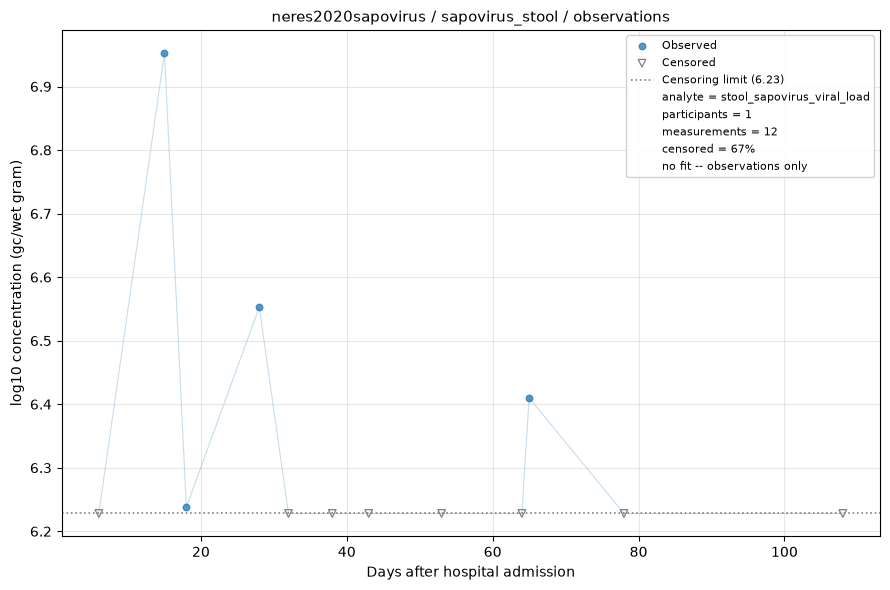
Measurements only — no shedding model is fitted to this analyte, usually because it is sampled once per participant, leaving no trajectory to fit, or because nothing was ever detected. Open triangles are non-detects, drawn at the assay's censoring limit. See the modelling methods for what these estimates do and do not support.