Isolation of viable monkeypox virus from anal and urethral swabs, Italy, May to July 2022 moschese2022isolation
Study of 33 laboratory-confirmed mpox cases attending a sexual health clinic in Milan, Italy (15 May–7 July 2022). Anal (rectal) and urethral swabs were tested for MPXV DNA by real-time PCR (reported as Cq) and, when PCR-positive, were inoculated on Vero E6 cells to attempt viral isolation; culture positivity/negativity (and time-to-positivity) were reported in the paper table, while the provided figure CSV contains Cq values over time (days since symptom onset) for anal and urethral swabs.
Analytes
anorectal_swab
MPXV DNA real-time PCR quantification cycle (Cq) values from anal (rectal) swabs; swabs collected in Universal Transport Medium (UTM-RT, Copan). Orthopoxvirus screening PCR (RealStar Orthopoxvirus PCR Kit 1.0) with confirmation by an in-house MPXV-specific real-time PCR. Values here are Cq (cycle threshold) reported by the study.
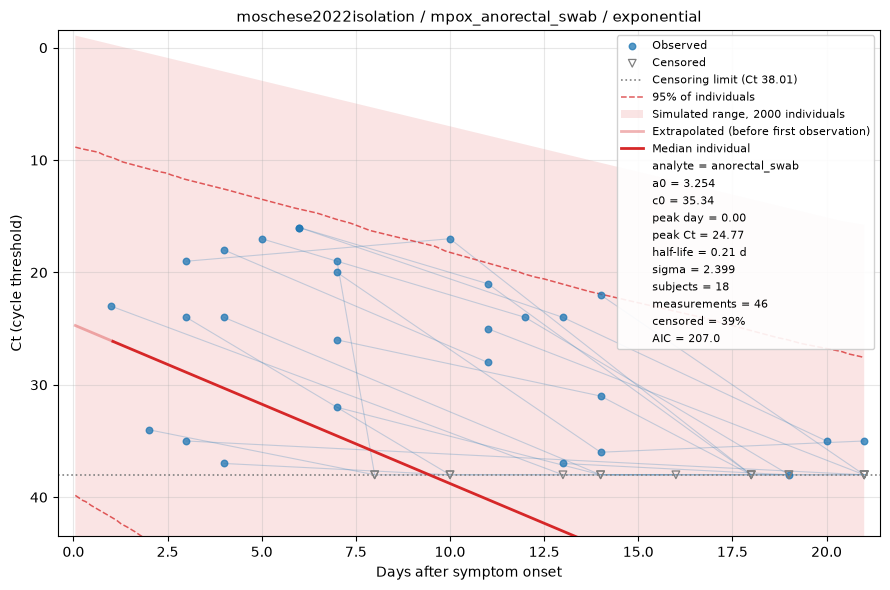
Fitted by censored maximum likelihood. The red line is the median individual; the shaded region is the full range of a simulated cohort drawn from the fitted population, so it shows what simulating from this dataset would produce rather than a confidence interval, with dashed lines at the central 95%. Open triangles are non-detects, drawn at the censoring limit and entering the fit as "below this value" rather than being dropped. See the modelling methods for what these estimates do and do not support.
urethral_swab
MPXV DNA real-time PCR quantification cycle (Cq) values from urethral swabs; swabs collected in Universal Transport Medium (UTM-RT, Copan). Orthopoxvirus screening PCR (RealStar Orthopoxvirus PCR Kit 1.0) with confirmation by an in-house MPXV-specific real-time PCR. Values here are Cq (cycle threshold) reported by the study.
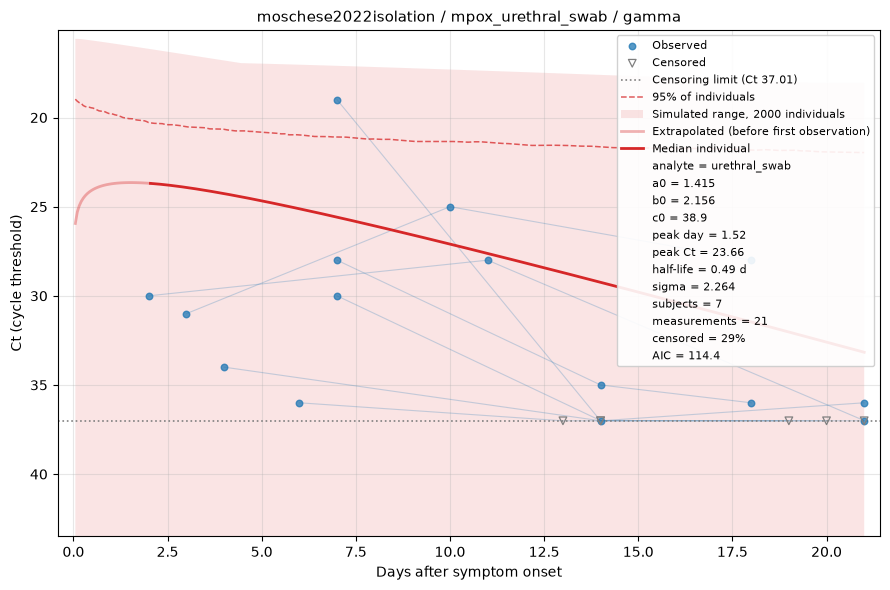
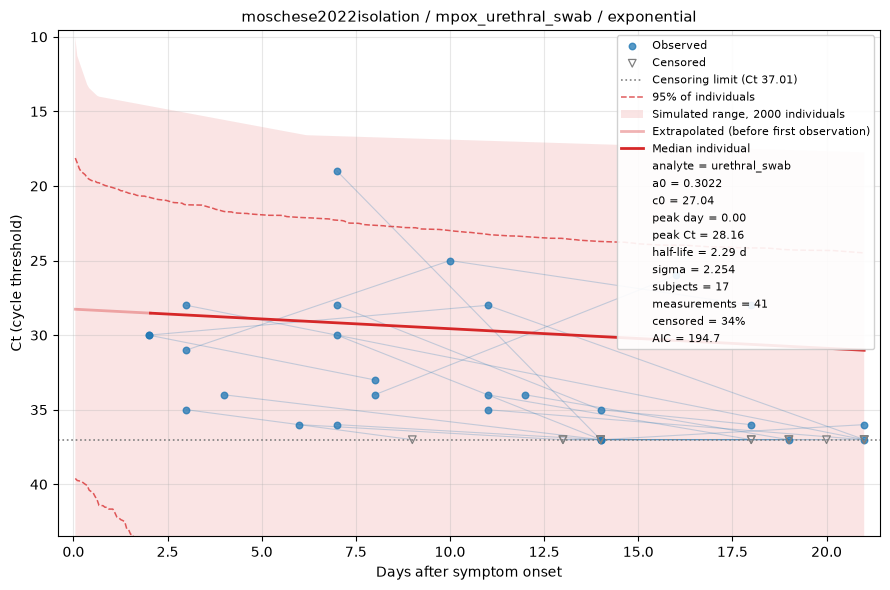
Fitted by censored maximum likelihood. The red line is the median individual; the shaded region is the full range of a simulated cohort drawn from the fitted population, so it shows what simulating from this dataset would produce rather than a confidence interval, with dashed lines at the central 95%. Open triangles are non-detects, drawn at the censoring limit and entering the fit as "below this value" rather than being dropped. See the modelling methods for what these estimates do and do not support.