Long-term viral shedding and viral genome mutation in norovirus infection miyoshi2015long
This study investigates the duration of viral shedding in patients from two outbreaks and four sporadic cases of norovirus (NoV) infections. The research highlights the longest period of viral shedding into feces, which was 173 days in an inpatient from one outbreak case. The study also examines the VP1 sequence from two long-term viral shedding cases, revealing several mutations. The findings suggest that the long-term carrier state of norovirus infection contributes to the generation of escape mutants by host immunoselection.
Analytes
stool_norovirus
Norovirus viral load measured in stool samples using quantitative PCR methods.
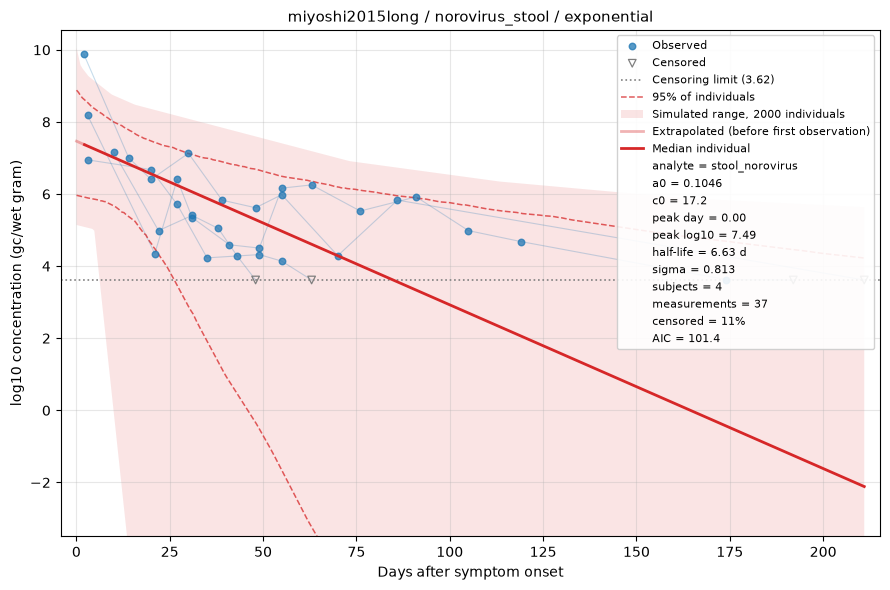
Fitted by censored maximum likelihood. The red line is the median individual; the shaded region is the full range of a simulated cohort drawn from the fitted population, so it shows what simulating from this dataset would produce rather than a confidence interval, with dashed lines at the central 95%. Open triangles are non-detects, drawn at the censoring limit and entering the fit as "below this value" rather than being dropped. See the modelling methods for what these estimates do and do not support.