Frequent and prolonged shedding of bocavirus in young children attending daycare martin2010frequent
Prospective longitudinal respiratory illness surveillance study of children attending daycare centers on Fort Lewis Army Base (Washington State, USA; surveillance Feb 2006–Apr 2008). Nasal swabs were collected at enrollment (sometimes asymptomatic) and weekly during respiratory illnesses, then tested retrospectively for human bocavirus (HBoV) by real-time PCR targeting the NP1 gene. Quantitative HBoV results were derived from a standard curve and reported as copies per mL of lysis buffer. CSV-derived measurements here provide longitudinal nasal HBoV quantities/positivity over time (days relative to enrollment baseline in the figure-derived dataset).
Analytes
nasal_hbov_viral_load
Human bocavirus (HBoV) real-time PCR targeting the NP1 gene. Study testing provided semiquantitative Ct results; for specimens with sufficient volume, Ct values were compared to a standard curve from a plasmid containing the HBoV amplicon to estimate viral quantity. Quantitative results reported as copies of virus per mL of lysis buffer. The figure-derived CSV contains a mix of numeric quantities and qualitative positive/negative calls.
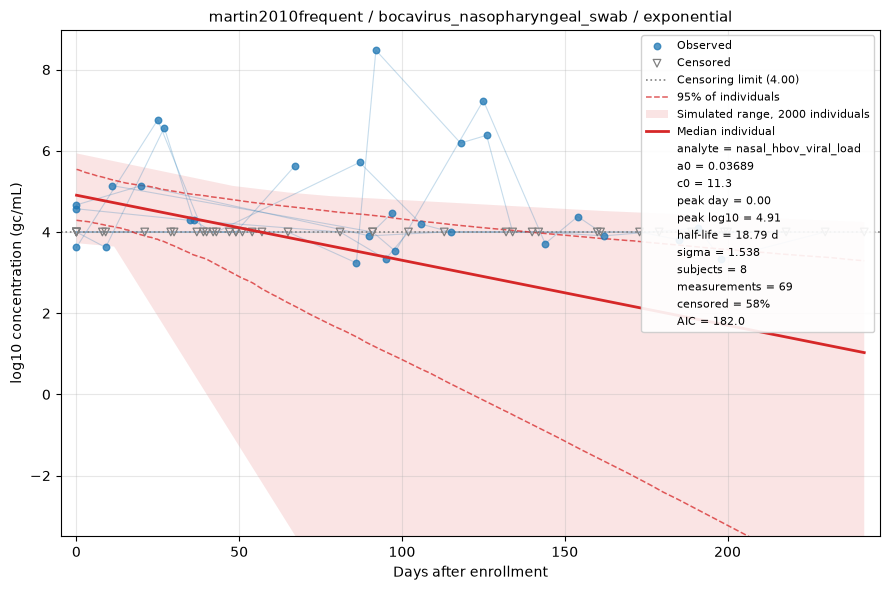
Fitted by censored maximum likelihood. The red line is the median individual; the shaded region is the full range of a simulated cohort drawn from the fitted population, so it shows what simulating from this dataset would produce rather than a confidence interval, with dashed lines at the central 95%. Open triangles are non-detects, drawn at the censoring limit and entering the fit as "below this value" rather than being dropped. See the modelling methods for what these estimates do and do not support.