Detection of hepatitis A virus RNA in saliva mackiewicz2004detection
This study, conducted from November 2002 to November 2003, investigated the presence of hepatitis A virus (HAV) RNA in saliva and serum samples from six acutely infected patients with HAV viremia. The study was conducted at a hospital in France, and the participants were aged between 15 and 47 years. The study aimed to explore the potential of using saliva samples for outbreak investigations due to the ease of collection. HAV RNA was detected in the saliva of five out of six patients, with viral loads in saliva being 2 logs lower than in serum. The study utilized RT-PCR and real-time PCR assays for detection and quantification, with a focus on the VP1/2A junction of the HAV genome. The study also included phylogenetic analysis to determine HAV genotypes.
Analytes
serum_HAV_RNA
HAV RNA was extracted from 140 μl of serum using the QIAmp viral RNA kit. RT-PCR was performed to amplify a 512-bp fragment encompassing the VP1/2A junction. The sensitivity of the RT-PCR assay was 43 IU/ml. HAV RNA was quantified using a real-time RT-PCR assay on the LightCycler instrument with a sensitivity of 600 genome equivalents/ml.
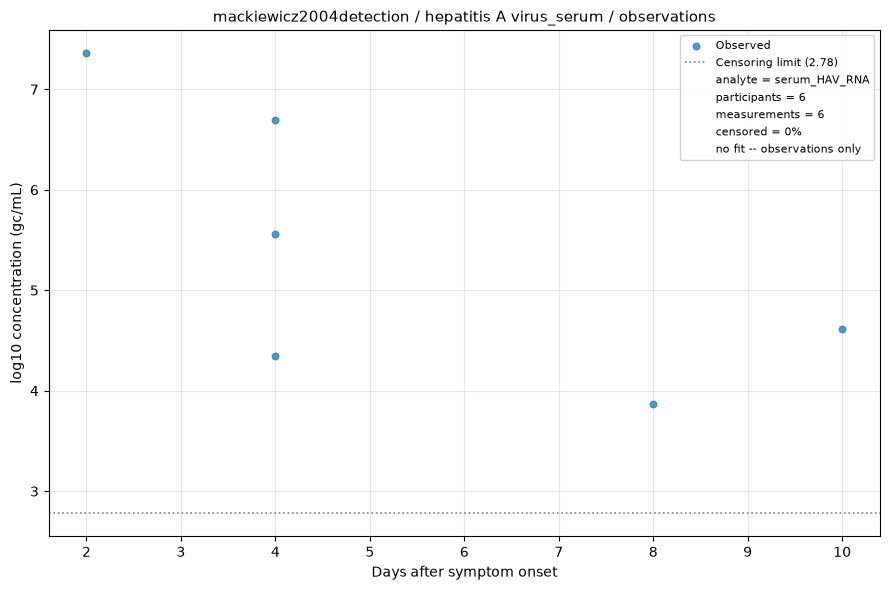
Measurements only — no shedding model is fitted to this analyte, usually because it is sampled once per participant, leaving no trajectory to fit, or because nothing was ever detected. Open triangles are non-detects, drawn at the assay's censoring limit. See the modelling methods for what these estimates do and do not support.
saliva_HAV_RNA
HAV RNA was extracted from 140 μl of saliva using the QIAmp viral RNA kit. RT-PCR was performed to amplify a 512-bp fragment encompassing the VP1/2A junction. The sensitivity of the RT-PCR assay was 43 IU/ml. HAV RNA was quantified using a real-time RT-PCR assay on the LightCycler instrument with a sensitivity of 600 genome equivalents/ml.
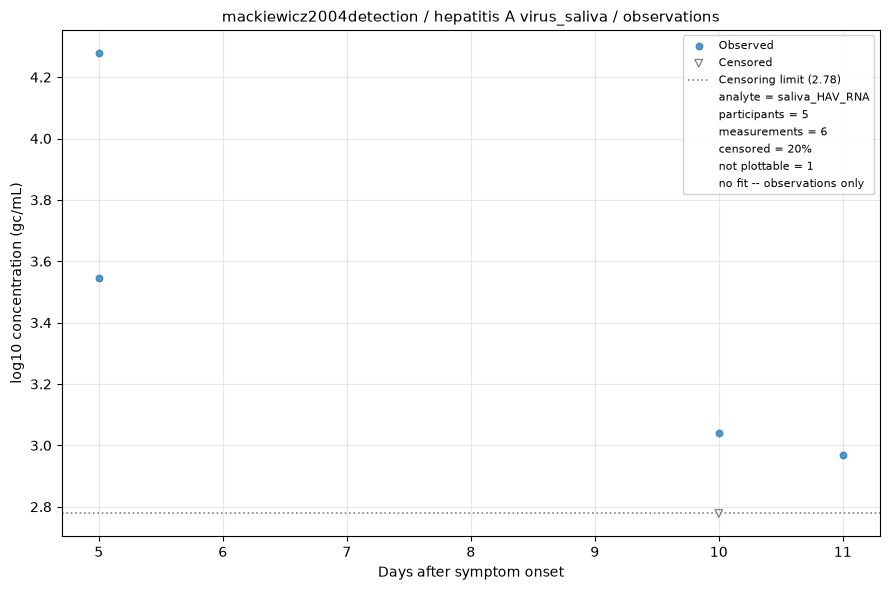
Measurements only — no shedding model is fitted to this analyte, usually because it is sampled once per participant, leaving no trajectory to fit, or because nothing was ever detected. Open triangles are non-detects, drawn at the assay's censoring limit. See the modelling methods for what these estimates do and do not support.