Influenza Virus Shedding in Laninamivir-Treated Children upon Returning to School kondo2016influenza
Study of influenza virus shedding in pediatric patients treated with laninamivir during the 2011-2012 influenza season in Niigata Prefecture, Japan. Nasal discharge samples were collected at three visits (before treatment, 3-5 days after first visit, and 5-9 days after first visit) and assessed by virus culture (TCID50) and quantitative real-time PCR targeting the M gene. The paper enrolled 28 children (7 infected with influenza A(H3N2) and 21 with influenza B) and evaluated duration of fever, virus isolation, viral RNA detection rates, and antiviral susceptibility. The CSV data provided contain quantitative viral RNA measurements (genome-equivalent copies) for a subset of participants.
Analytes
nasal_discharge_influenza_gc_per_mL
Quantitative real-time PCR (TaqMan) targeting the influenza M gene on nasal discharge specimens. Viral load expressed as genome-equivalent copies of viral RNA using a standard curve; samples run in duplicate. A cycle threshold (Ct) < 40 was considered positive. Values reported here are genome-equivalent copies (converted to numeric).
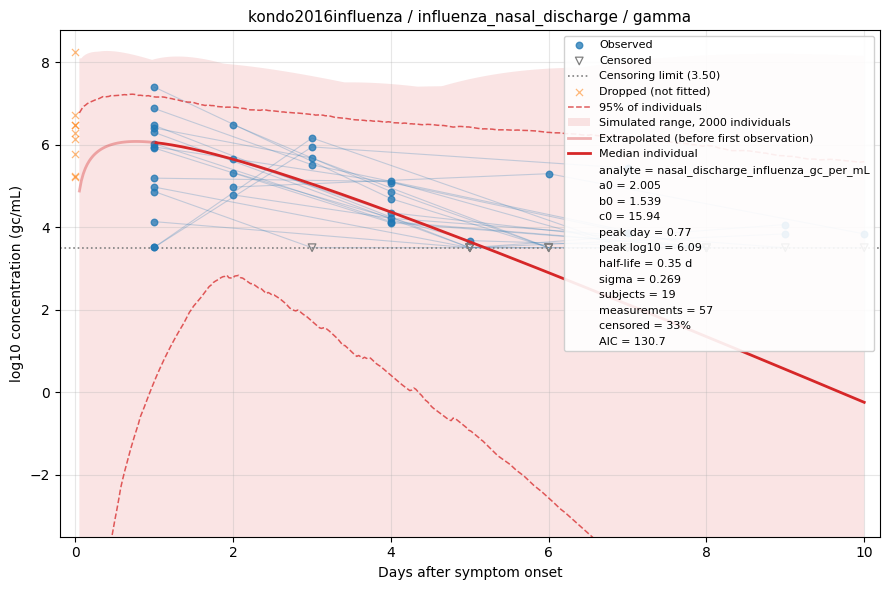
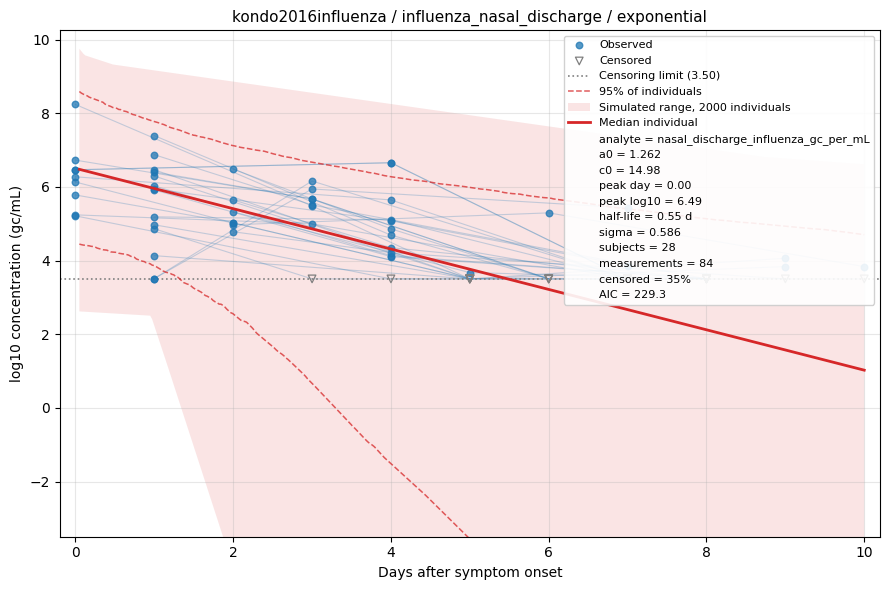
Fitted by censored maximum likelihood. The red line is the median individual; the shaded region is the full range of a simulated cohort drawn from the fitted population, so it shows what simulating from this dataset would produce rather than a confidence interval, with dashed lines at the central 95%. Open triangles are non-detects, drawn at the censoring limit and entering the fit as "below this value" rather than being dropped. See the modelling methods for what these estimates do and do not support.