Vomiting as a Symptom and Transmission Risk in Norovirus Illness: Evidence from Human Challenge Studies kirby2016vomiting
This study investigates the role of vomiting in norovirus transmission using data from human challenge studies with GI.1 Norwalk virus, GII.2 Snow Mountain virus, and a pilot study with GII.1 Hawaii virus. The study involved healthy adult subjects who were challenged with norovirus and monitored for symptoms, including vomiting. Emesis samples were collected and analyzed for viral titers using strain-specific quantitative RT-PCR. The study found that vomiting is a common symptom in norovirus infection and contributes significantly to environmental contamination and transmission risk. The study provides quantitative data on virus titers in emesis, which is critical for risk assessment and control measures.
Analytes
emesis_norovirus_GI
Norovirus GI viral titers in emesis samples measured using strain-specific quantitative RT-PCR.
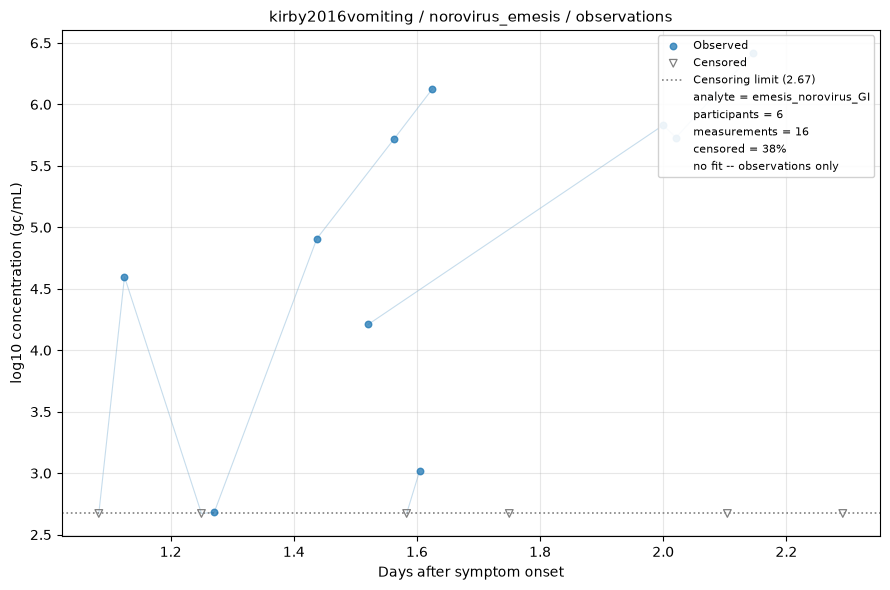
Measurements only — no shedding model is fitted to this analyte, usually because it is sampled once per participant, leaving no trajectory to fit, or because nothing was ever detected. Open triangles are non-detects, drawn at the assay's censoring limit. See the modelling methods for what these estimates do and do not support.
emesis_norovirus_GII
Norovirus GII viral titers in emesis samples measured using strain-specific quantitative RT-PCR.
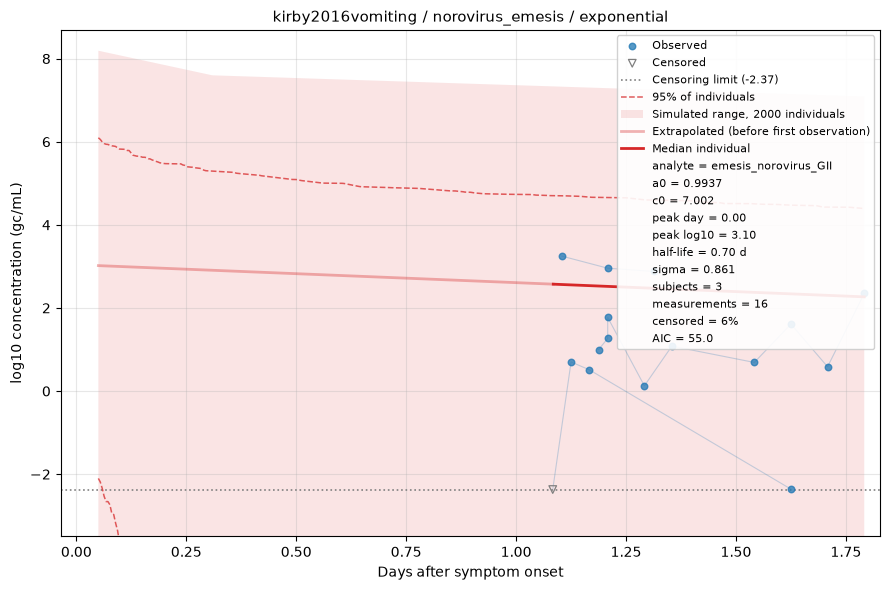
Fitted by censored maximum likelihood. The red line is the median individual; the shaded region is the full range of a simulated cohort drawn from the fitted population, so it shows what simulating from this dataset would produce rather than a confidence interval, with dashed lines at the central 95%. Open triangles are non-detects, drawn at the censoring limit and entering the fit as "below this value" rather than being dropped. See the modelling methods for what these estimates do and do not support.
stool_norovirus_GI
Norovirus GI viral titers in stool samples measured using strain-specific quantitative RT-PCR.
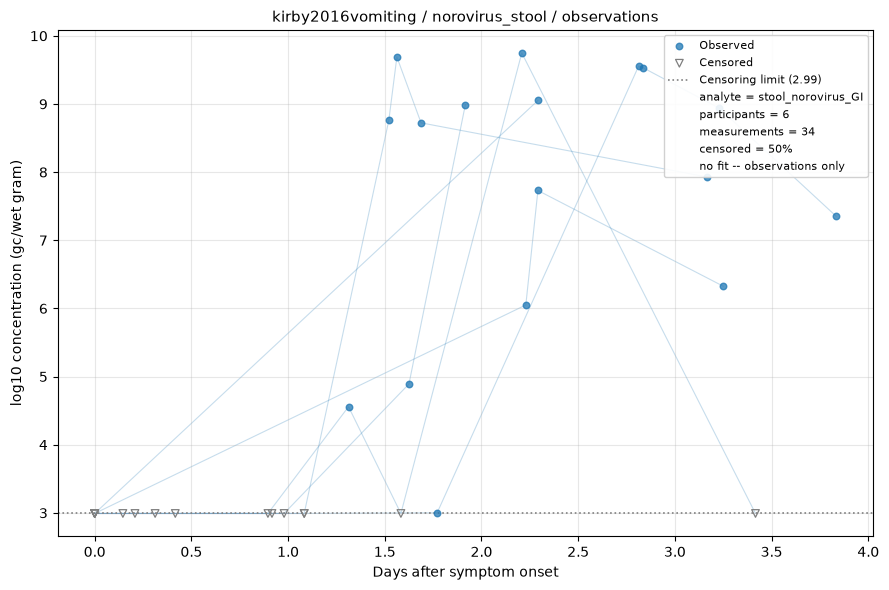
Measurements only — no shedding model is fitted to this analyte, usually because it is sampled once per participant, leaving no trajectory to fit, or because nothing was ever detected. Open triangles are non-detects, drawn at the assay's censoring limit. See the modelling methods for what these estimates do and do not support.
stool_norovirus_GII
Norovirus GII viral titers in stool samples measured using strain-specific quantitative RT-PCR.
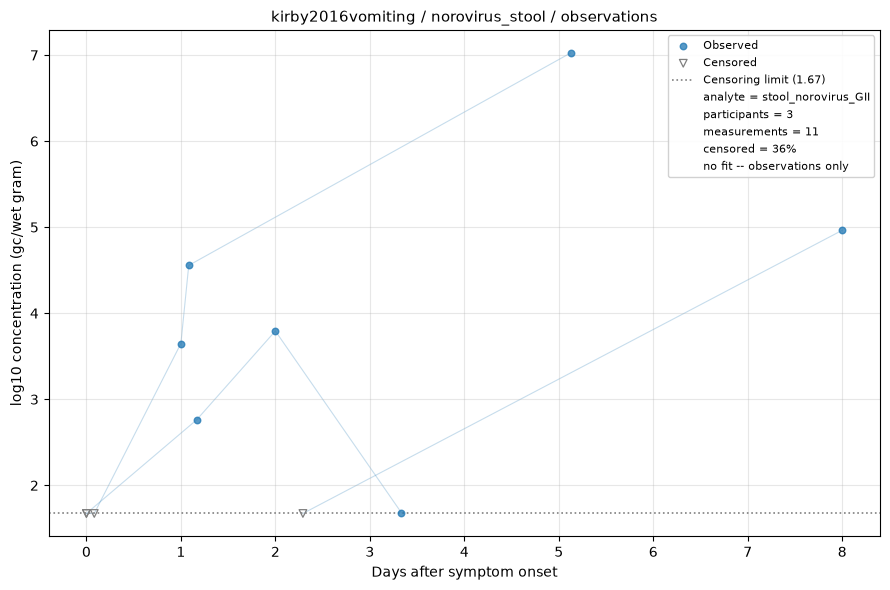
Measurements only — no shedding model is fitted to this analyte, usually because it is sampled once per participant, leaving no trajectory to fit, or because nothing was ever detected. Open triangles are non-detects, drawn at the assay's censoring limit. See the modelling methods for what these estimates do and do not support.