Shedding of pandemic (H1N1) 2009 virus among health care personnel, Seattle, Washington, USA kay2011shedding
Outbreak investigation of pandemic (H1N1) 2009 among hospital-associated retreat attendees in Seattle (September 2009). Sixteen health care personnel with laboratory-confirmed infection provided serial self-collected nasal wash specimens (every Mon/Wed/Fri) and symptom logs; specimens were tested by real-time RT-PCR (quantified as RNA copies/mL) and rapid culture. Study evaluated duration of viral RNA detection and culture positivity relative to symptom onset and fever, and found RT-PCR detection lasted longer (3–13 days) than culture (3–10 days). All infected HCP received oseltamivir early in illness.
Analytes
nasal_lavage_influenza_gc_per_mL
Real-time RT-PCR quantification of influenza (pandemic H1N1 2009) viral RNA concentration measured in self-collected nasal wash (nasal lavage) specimens. Samples were also tested by rapid culture (culture not quantified). Real-time RT-PCR performed at the University of Washington Virology Laboratory; lower detection limit reported as 3 log10 copies/mL.
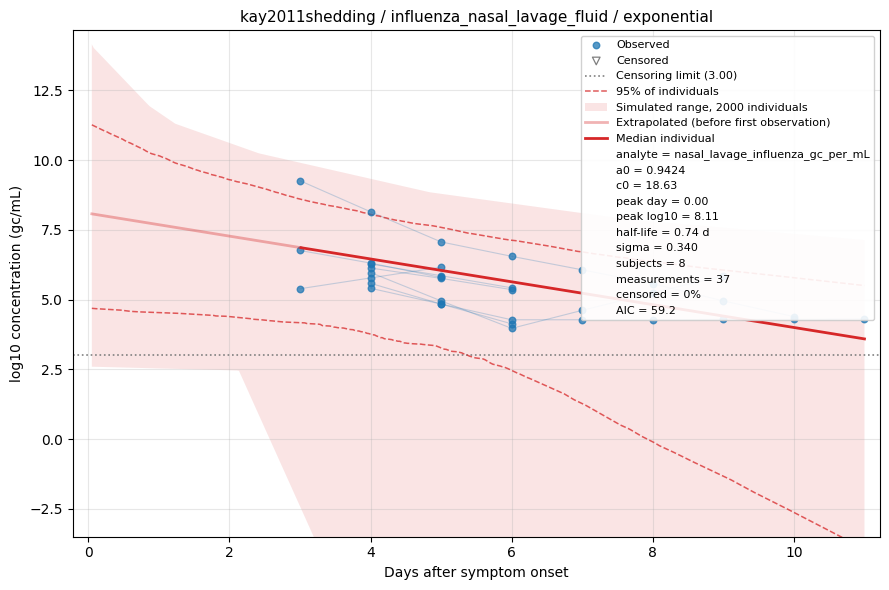
Fitted by censored maximum likelihood. The red line is the median individual; the shaded region is the full range of a simulated cohort drawn from the fitted population, so it shows what simulating from this dataset would produce rather than a confidence interval, with dashed lines at the central 95%. Open triangles are non-detects, drawn at the censoring limit and entering the fit as "below this value" rather than being dropped. See the modelling methods for what these estimates do and do not support.