Differentiation between Wild-Type Group A Rotaviruses and Vaccine Strains in Cases of Suspected Horizontal Transmission and Adverse Events Following Vaccination jacobsen2022differentiation
This study investigates the differentiation between wild-type Group A rotaviruses (RVA) and vaccine strains in cases of suspected horizontal transmission and adverse events following vaccination. Conducted in Germany, the study involved 74 patients, including 68 vaccinated children and 6 cases of suspected horizontal transmission, from 2009 to 2019. The study utilized a PCR-based algorithm to distinguish between vaccine-like and wild-type RVA strains in stool samples. The study found that vaccine-like virus was detected in 46 samples, wild-type RVA in 6 samples, and mixed infections in 3 samples. The study also explored co-infections with other pathogens and the shedding of vaccine strains in immunocompromised patients.
Analytes
stool_rotavirus_vaccine_RV1
Rotarix (RV1) vaccine shedding after vaccination
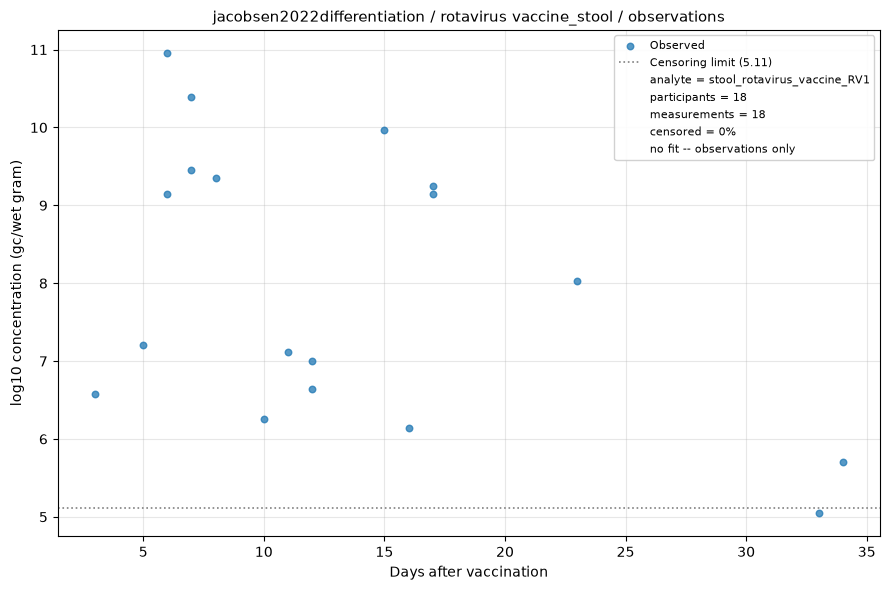
Measurements only — no shedding model is fitted to this analyte, usually because it is sampled once per participant, leaving no trajectory to fit, or because nothing was ever detected. Open triangles are non-detects, drawn at the assay's censoring limit. See the modelling methods for what these estimates do and do not support.
stool_rotavirus_vaccine_RV5
RotaTeq (RV5) vaccine shedding after vaccination
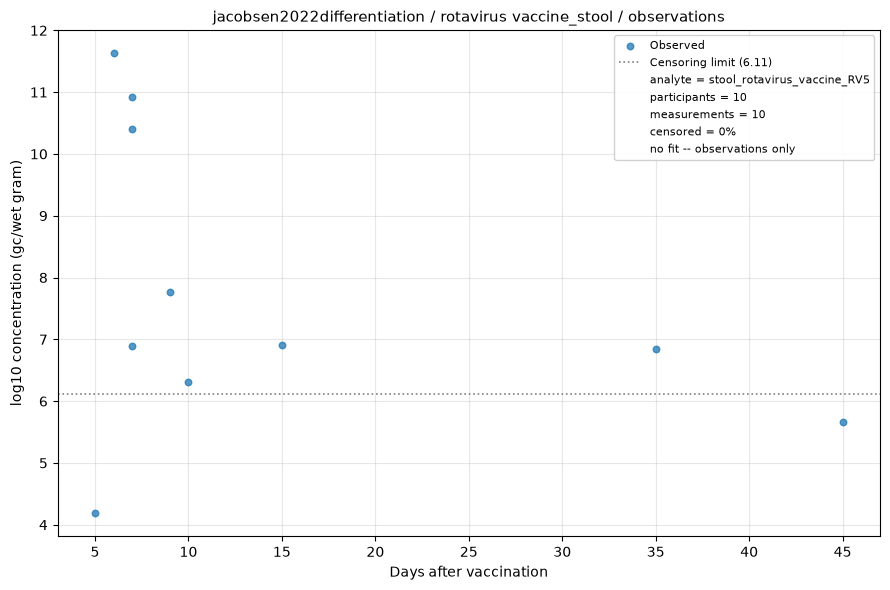
Measurements only — no shedding model is fitted to this analyte, usually because it is sampled once per participant, leaving no trajectory to fit, or because nothing was ever detected. Open triangles are non-detects, drawn at the assay's censoring limit. See the modelling methods for what these estimates do and do not support.