Similarities in rotavirus vaccine viral shedding and immune responses in pairs of twins enya2023similarities
Prospective cohort study of 20 infants (four twin pairs and twelve singletons) admitted to the neonatal intensive care unit at Fujita Health University Hospital (Japan), born Nov 2018–Jun 2020, receiving two doses of Rotarix (RV1). Stool was collected daily from vaccination day (day 0) through day 8 after each dose to quantify fecal RV1 vaccine-strain shedding by RV1-specific qRT-PCR (reported here as gene copies per PCR reaction from figure-derived CSV).
Analytes
1_gc_reaction
Fecal rotavirus vaccine strain (Rotarix/RV1) RNA shedding quantified by RV1-specific qRT-PCR from stool suspensions; values reported as gene copies per PCR reaction (gc/reaction) after dose 1.
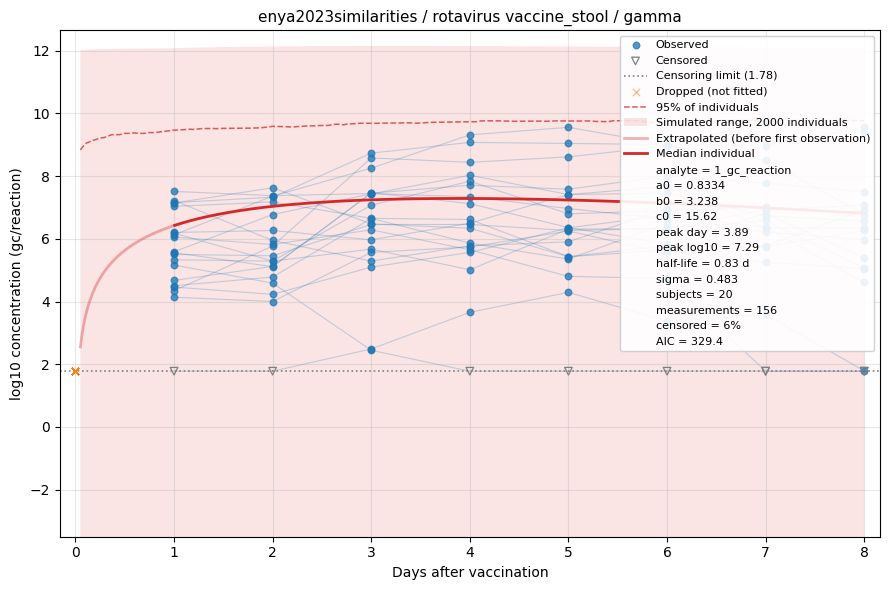
Fitted by censored maximum likelihood. The red line is the median individual; the shaded region is the full range of a simulated cohort drawn from the fitted population, so it shows what simulating from this dataset would produce rather than a confidence interval, with dashed lines at the central 95%. Open triangles are non-detects, drawn at the censoring limit and entering the fit as "below this value" rather than being dropped. See the modelling methods for what these estimates do and do not support.
2_gc_reaction
Fecal rotavirus vaccine strain (Rotarix/RV1) RNA shedding quantified by RV1-specific qRT-PCR from stool suspensions; values reported as gene copies per PCR reaction (gc/reaction) after dose 2.
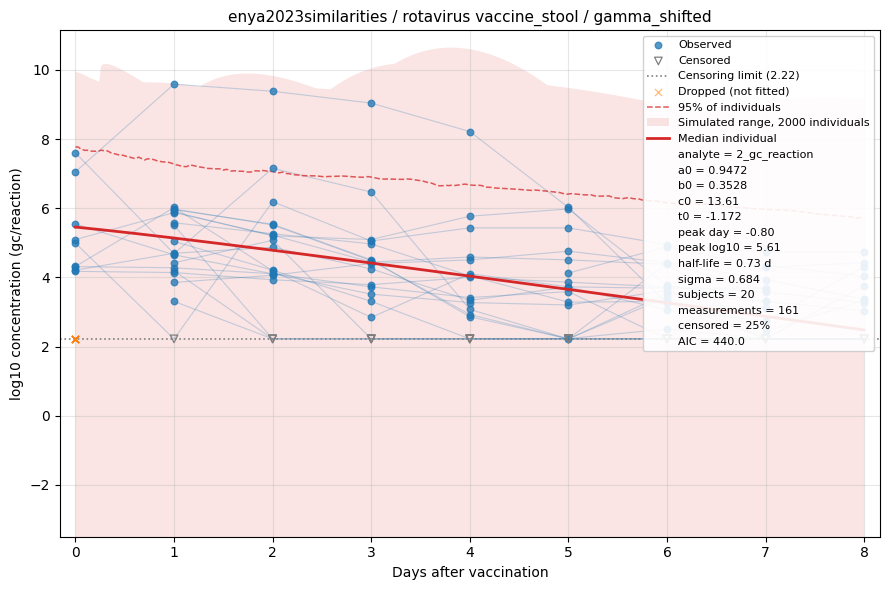
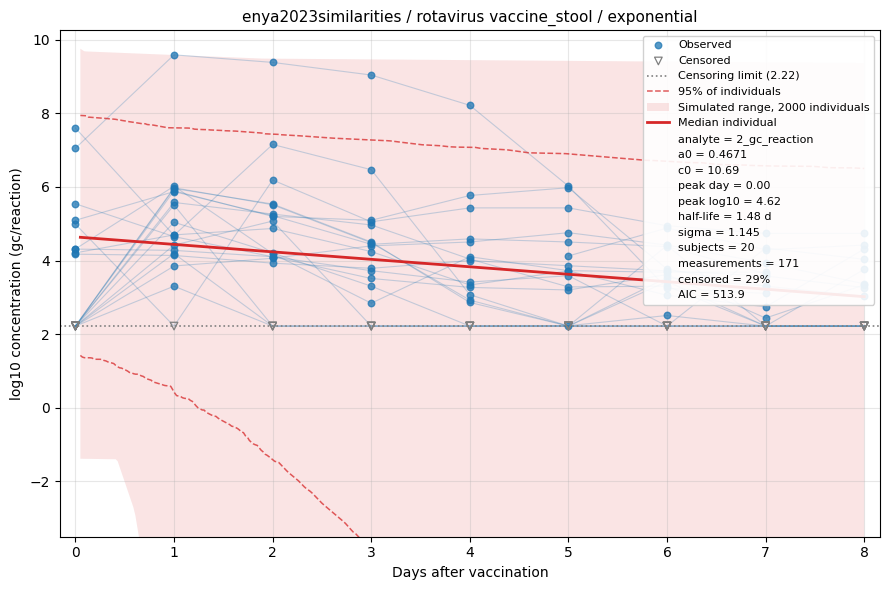
Fitted by censored maximum likelihood. The red line is the median individual; the shaded region is the full range of a simulated cohort drawn from the fitted population, so it shows what simulating from this dataset would produce rather than a confidence interval, with dashed lines at the central 95%. Open triangles are non-detects, drawn at the censoring limit and entering the fit as "below this value" rather than being dropped. See the modelling methods for what these estimates do and do not support.