Safety and Antiviral Effects of Nebulized PC786 in a Respiratory Syncytial Virus Challenge Study devincenzo2022safety
Randomized, single-blind, placebo-controlled RSV-A (Memphis 37b) human challenge study in healthy adult volunteers (18–55 years). Participants were inoculated intranasally on study day 0 and received nebulized PC786 (5 mg) or placebo twice daily for 5 days starting ~12 hours after RSV detection or on day 6. RSV viral load was monitored in nasal wash samples by Simplexa RT-qPCR; this extraction includes individual-level measurements digitized to CSV (PatientID, day, value, treatment).
Analytes
nasal_wash_respiratory_syncytial_virus_rna_pcr_pfu_equivalents
RSV RNA viral load in nasal wash samples measured using a Simplexa reverse-transcription quantitative PCR (RT-qPCR) assay; reported in plaque-forming unit equivalents (PFUe) per mL as used in the manuscript for RSV RNA quantification/cutoffs (e.g., >0 log10 PFUe/mL; >=1 log10 PFUe/mL). CSV provides numeric viral load values over time (days) after inoculation/treatment period (exact reference event for CSV not specified).
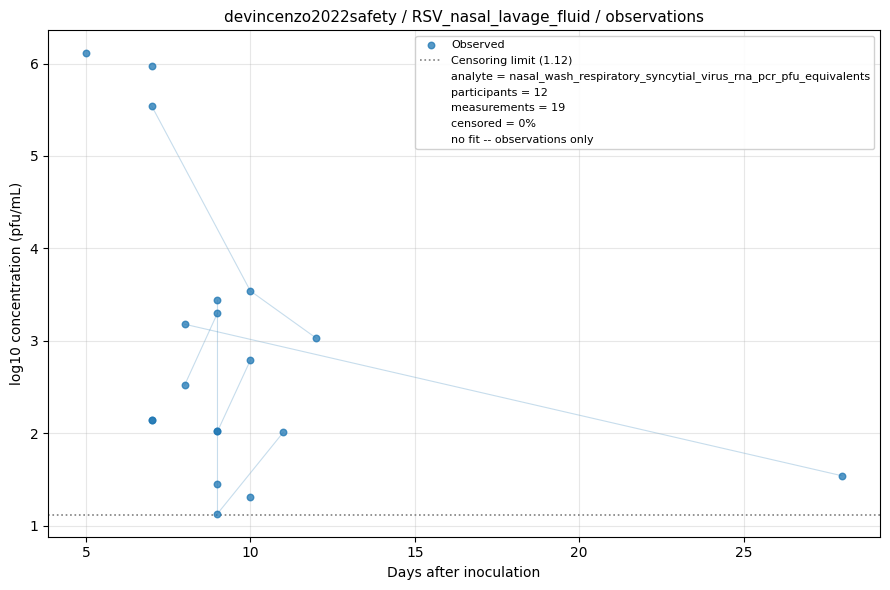
Measurements only — no shedding model is fitted to this analyte, usually because it is sampled once per participant, leaving no trajectory to fit, or because nothing was ever detected. Open triangles are non-detects, drawn at the assay's censoring limit. See the modelling methods for what these estimates do and do not support.