Kinetics of viral DNA in body fluids and antibody response in patients with acute Monkeypox virus infection colavita2023kinetics
Case series follow-up study of three mpox (Monkeypox virus, MPXV) cases diagnosed and monitored at the National Institute for Infectious Diseases “Lazzaro Spallanzani” (INMI) in Rome, Italy, during May–June 2022. Longitudinal non-lesion specimens (oropharyngeal swab/OPS, saliva, plasma, urine, stool, semen) were tested for MPXV DNA using rtPCR (Ct values; target CrmB gene, Ct>40 negative), with quantification on a subset by droplet digital PCR (ddPCR) and infectivity assessed by viral culture on Vero E6 cells. CSV figure-derived data here provide per-patient time series of Ct values and MPXV DNA concentration normalized to extracted nucleic acid (gc/ng) at specific days post symptom onset.
Analytes
urine_ct
MPXV DNA detection by real-time PCR (rtPCR) targeting the CrmB gene (Li et al. 2010 assay); Ct>40 considered negative. Ct values used as surrogate of viral DNA load. Measurements are days since symptom onset.
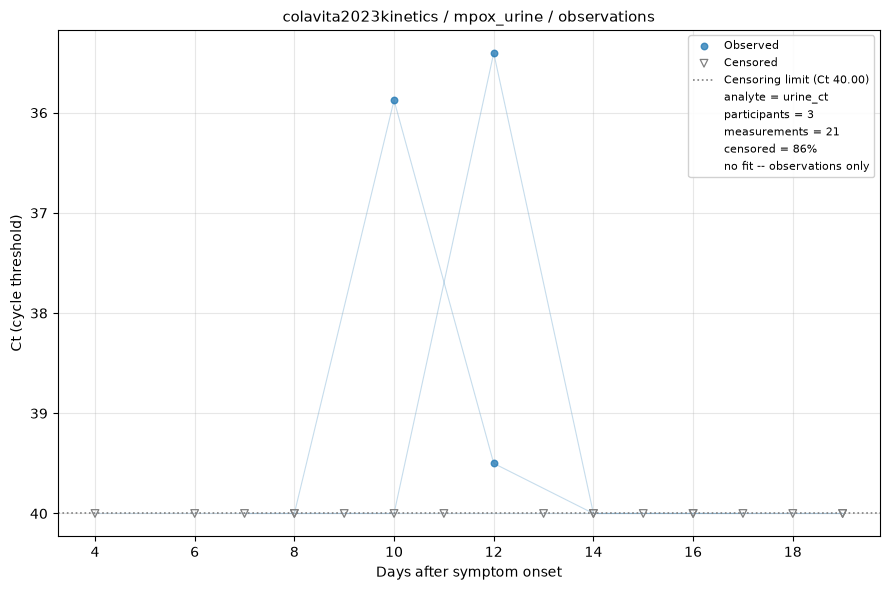
Measurements only — no shedding model is fitted to this analyte, usually because it is sampled once per participant, leaving no trajectory to fit, or because nothing was ever detected. Open triangles are non-detects, drawn at the assay's censoring limit. See the modelling methods for what these estimates do and do not support.
semen_ct
MPXV DNA detection by real-time PCR (rtPCR) targeting the CrmB gene (Li et al. 2010 assay); Ct>40 considered negative. Ct values used as surrogate of viral DNA load. Measurements are days since symptom onset.
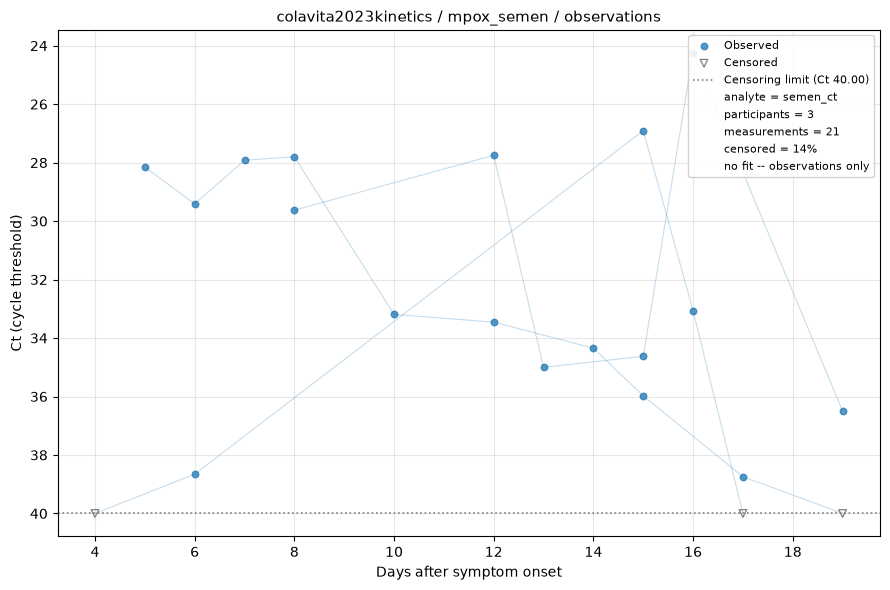
Measurements only — no shedding model is fitted to this analyte, usually because it is sampled once per participant, leaving no trajectory to fit, or because nothing was ever detected. Open triangles are non-detects, drawn at the assay's censoring limit. See the modelling methods for what these estimates do and do not support.
stool_ct
MPXV DNA detection by real-time PCR (rtPCR) targeting the CrmB gene (Li et al. 2010 assay); Ct>40 considered negative. Ct values used as surrogate of viral DNA load. Measurements are days since symptom onset.
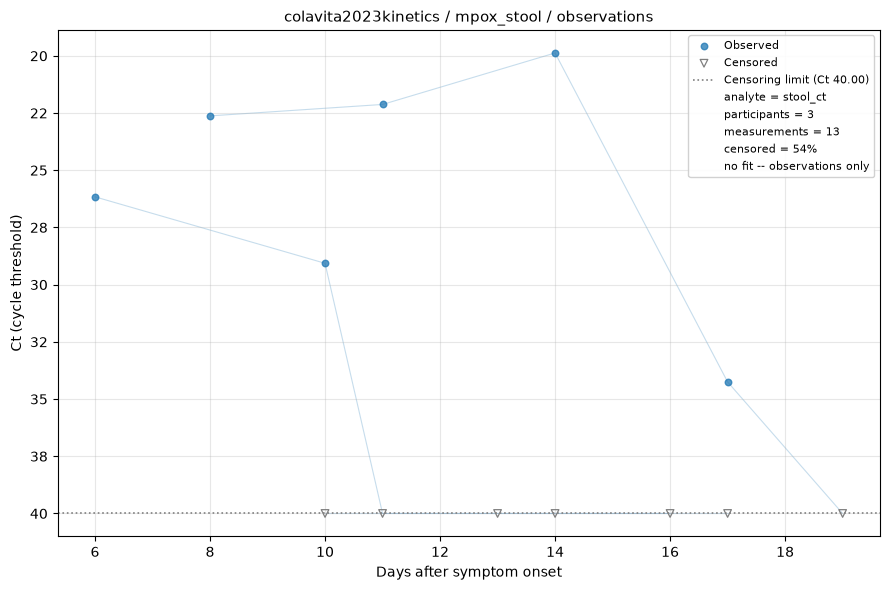
Measurements only — no shedding model is fitted to this analyte, usually because it is sampled once per participant, leaving no trajectory to fit, or because nothing was ever detected. Open triangles are non-detects, drawn at the assay's censoring limit. See the modelling methods for what these estimates do and do not support.
plasma_ct
MPXV DNA detection by real-time PCR (rtPCR) targeting the CrmB gene (Li et al. 2010 assay); Ct>40 considered negative. Ct values used as surrogate of viral DNA load. Measurements are days since symptom onset.
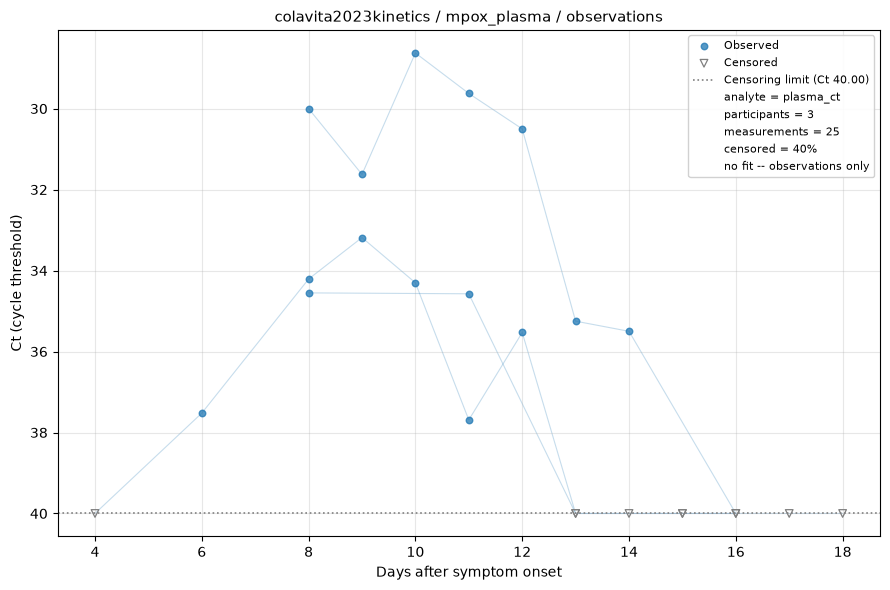
Measurements only — no shedding model is fitted to this analyte, usually because it is sampled once per participant, leaving no trajectory to fit, or because nothing was ever detected. Open triangles are non-detects, drawn at the assay's censoring limit. See the modelling methods for what these estimates do and do not support.
saliva_ct
MPXV DNA detection by real-time PCR (rtPCR) targeting the CrmB gene (Li et al. 2010 assay); Ct>40 considered negative. Ct values used as surrogate of viral DNA load. Measurements are days since symptom onset.
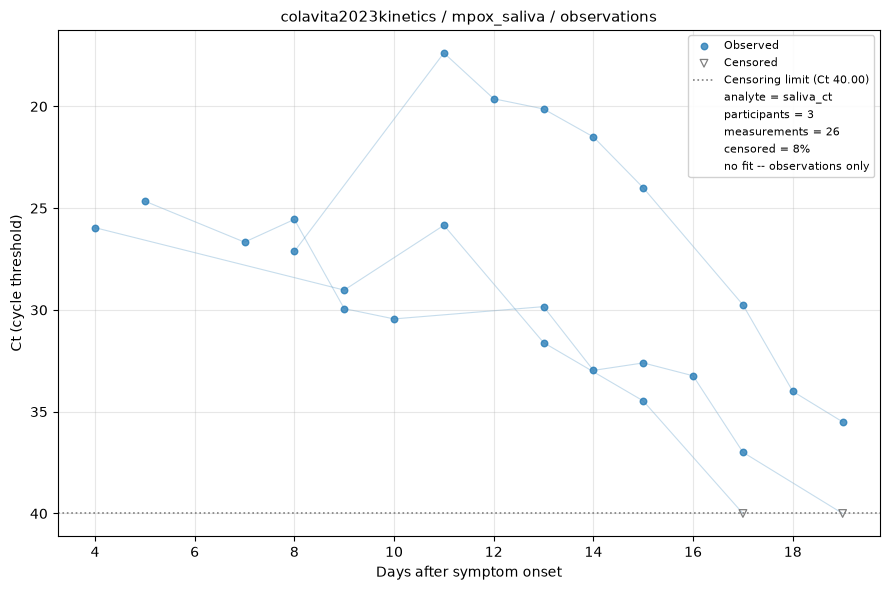
Measurements only — no shedding model is fitted to this analyte, usually because it is sampled once per participant, leaving no trajectory to fit, or because nothing was ever detected. Open triangles are non-detects, drawn at the assay's censoring limit. See the modelling methods for what these estimates do and do not support.
oropharyngeal_swab_ct
MPXV DNA detection by real-time PCR (rtPCR) targeting the CrmB gene (Li et al. 2010 assay); Ct>40 considered negative. Ct values used as surrogate of viral DNA load. Measurements are days since symptom onset.
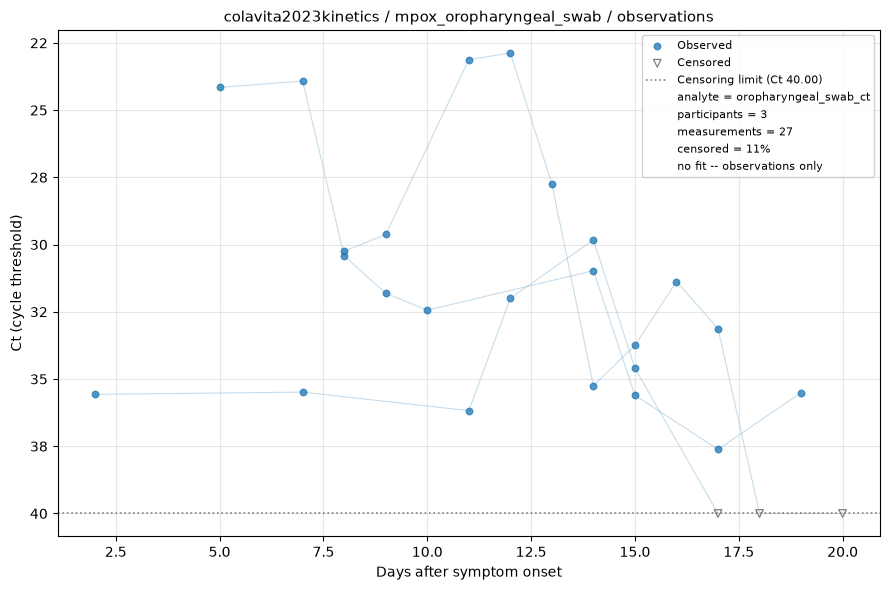
Measurements only — no shedding model is fitted to this analyte, usually because it is sampled once per participant, leaving no trajectory to fit, or because nothing was ever detected. Open triangles are non-detects, drawn at the assay's censoring limit. See the modelling methods for what these estimates do and do not support.
oropharyngeal_swab_gc_ng
MPXV DNA quantification by droplet digital PCR (ddPCR) adapted from the rtPCR design targeting the CrmB gene (Bio-Rad QX200 system). Figure CSV reports concentration values as gene copies per ng of extracted nucleic acid (gc/ng). Measurements are days since symptom onset.
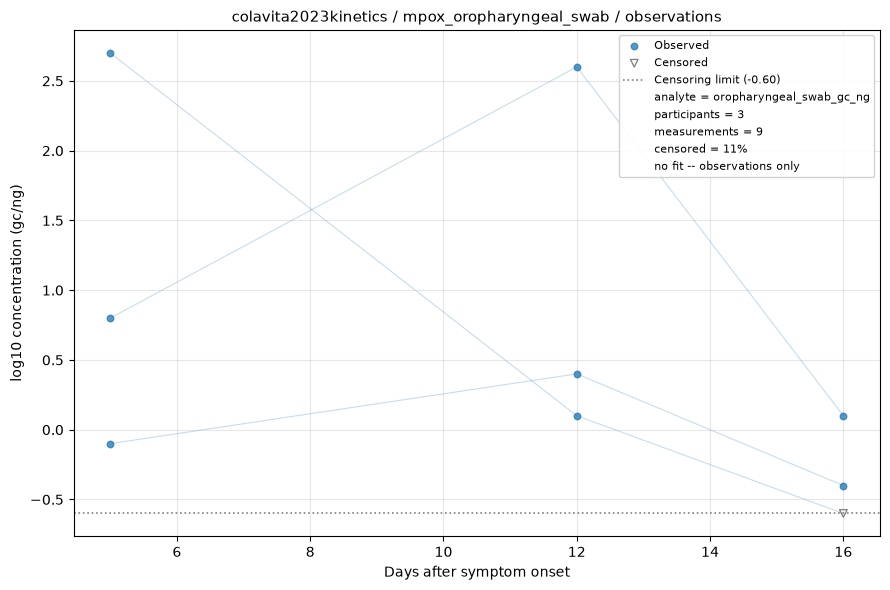
Measurements only — no shedding model is fitted to this analyte, usually because it is sampled once per participant, leaving no trajectory to fit, or because nothing was ever detected. Open triangles are non-detects, drawn at the assay's censoring limit. See the modelling methods for what these estimates do and do not support.
saliva_gc_ng
MPXV DNA quantification by droplet digital PCR (ddPCR) adapted from the rtPCR design targeting the CrmB gene (Bio-Rad QX200 system). Figure CSV reports concentration values as gene copies per ng of extracted nucleic acid (gc/ng). Measurements are days since symptom onset.
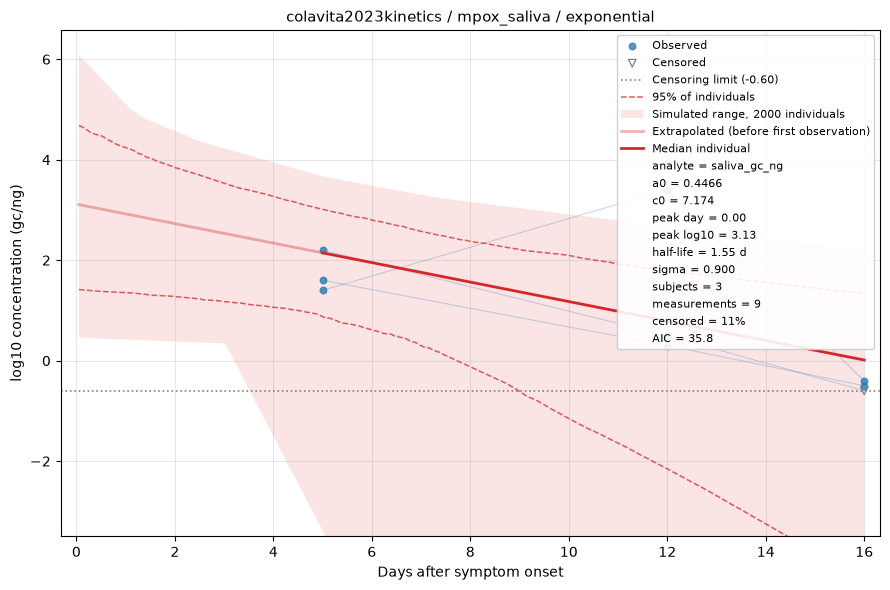
Fitted by censored maximum likelihood. The red line is the median individual; the shaded region is the full range of a simulated cohort drawn from the fitted population, so it shows what simulating from this dataset would produce rather than a confidence interval, with dashed lines at the central 95%. Open triangles are non-detects, drawn at the censoring limit and entering the fit as "below this value" rather than being dropped. See the modelling methods for what these estimates do and do not support.
plasma_gc_ng
MPXV DNA quantification by droplet digital PCR (ddPCR) adapted from the rtPCR design targeting the CrmB gene (Bio-Rad QX200 system). Figure CSV reports concentration values as gene copies per ng of extracted nucleic acid (gc/ng). Measurements are days since symptom onset.
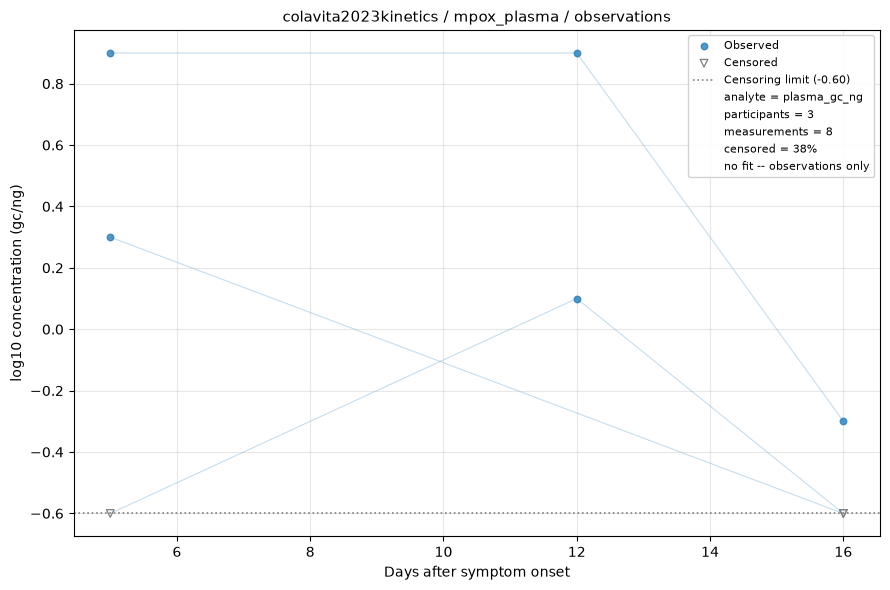
Measurements only — no shedding model is fitted to this analyte, usually because it is sampled once per participant, leaving no trajectory to fit, or because nothing was ever detected. Open triangles are non-detects, drawn at the assay's censoring limit. See the modelling methods for what these estimates do and do not support.
stool_gc_ng
MPXV DNA quantification by droplet digital PCR (ddPCR) adapted from the rtPCR design targeting the CrmB gene (Bio-Rad QX200 system). Figure CSV reports concentration values as gene copies per ng of extracted nucleic acid (gc/ng). Measurements are days since symptom onset.
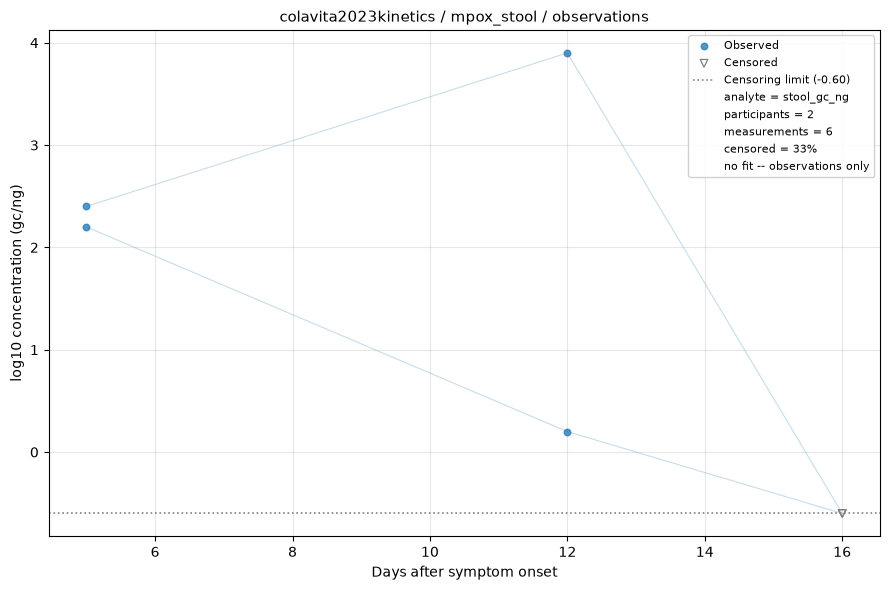
Measurements only — no shedding model is fitted to this analyte, usually because it is sampled once per participant, leaving no trajectory to fit, or because nothing was ever detected. Open triangles are non-detects, drawn at the assay's censoring limit. See the modelling methods for what these estimates do and do not support.
semen_gc_ng
MPXV DNA quantification by droplet digital PCR (ddPCR) adapted from the rtPCR design targeting the CrmB gene (Bio-Rad QX200 system). Figure CSV reports concentration values as gene copies per ng of extracted nucleic acid (gc/ng). Measurements are days since symptom onset.
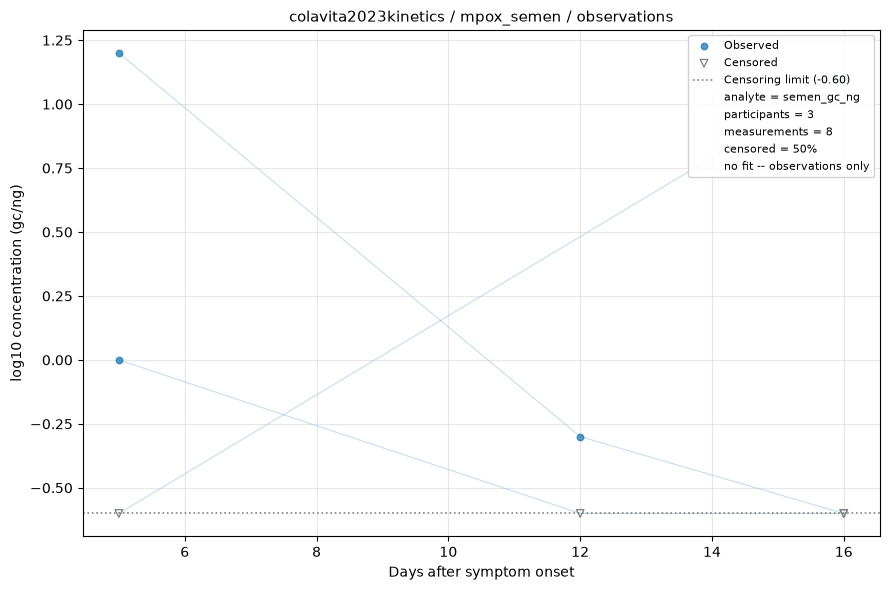
Measurements only — no shedding model is fitted to this analyte, usually because it is sampled once per participant, leaving no trajectory to fit, or because nothing was ever detected. Open triangles are non-detects, drawn at the assay's censoring limit. See the modelling methods for what these estimates do and do not support.