A pilot study on use of live attenuated rotavirus vaccine (Rotarix™) as an infection challenge model chilengi2020pilot
This study evaluates the use of Rotarix™ as a live-attenuated challenge agent in a cohort of 22 Zambian infants. The infants received two standard doses of the vaccine at 6 and 10 weeks of age. The study aimed to assess stool shedding of rotavirus using NSP2 qPCR, with samples collected on days 0, 3, 5, 7, 14, and 28 following each dose. The primary outcome was the viral shedding index, calculated as the average natural logarithm of viral copies per gram of stool. The study found that viral shedding was high after the first dose but reduced after the second dose, indicating the induction of mucosal immunity. The study supports the use of Rotarix as a live-attenuated infection challenge model.
Analytes
stool_rotavirus_viral_load
Stool shedding of rotavirus was determined by NSP2 qPCR, measuring the viral copies per gram of stool.
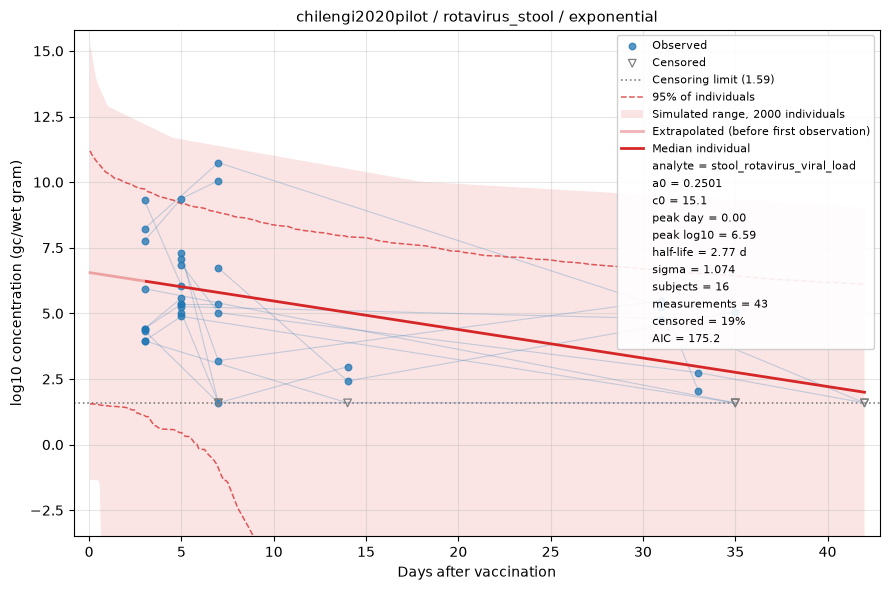
Fitted by censored maximum likelihood. The red line is the median individual; the shaded region is the full range of a simulated cohort drawn from the fitted population, so it shows what simulating from this dataset would produce rather than a confidence interval, with dashed lines at the central 95%. Open triangles are non-detects, drawn at the censoring limit and entering the fit as "below this value" rather than being dropped. See the modelling methods for what these estimates do and do not support.