Prolonged viral replication and longitudinal viral dynamic differences among respiratory syncytial virus infected infants brint2017prolonged
Longitudinal RSV viral load study in 51 naturally infected, hospitalized RSV-PCR+ infants (<1 year old) during the 2014–2015 RSV season. Quantitative nasal aspirate/nasal wash samples were collected serially during hospitalization and follow-up visits up to ~1 month after symptom onset. Viral load was measured using TaqMan-based real-time qRT-PCR targeting the RSV N gene with subtype-specific primers (RSV-A and RSV-B), and results were reported as plaque-forming unit equivalents per mL.
Analytes
nasal_aspirate_respiratory_syncytial_virus_viral_load
RSV viral load quantified from nasal aspirate/nasal wash using RNA extraction (Qiagen EZ1 Virus Minikit v2.0 on EZ1 Advanced XL) followed by reverse transcription and TaqMan-based real-time qRT-PCR (ABI Prism 7900HT and 7500Fast). Assay used custom RSV-A and RSV-B subtype-specific primers targeting the RSV N gene; quantification used 10-fold dilution internal standard curves from quantitatively cultured RSV-A and RSV-B whole virus. Results reported as PFU equivalents per mL; CSV values provided in linear scale corresponding to PFUe/mL (converted from reported log10 PFUe/mL in the paper figures).
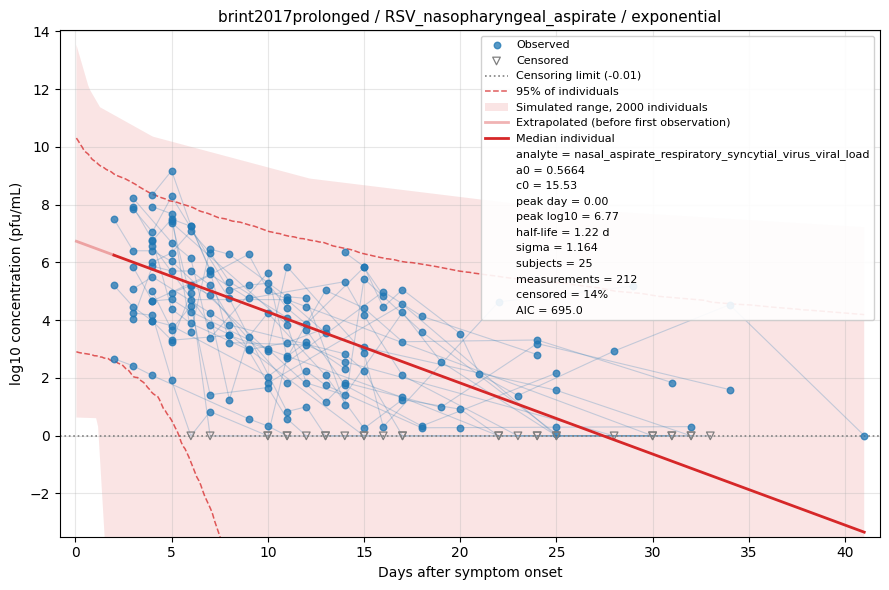
Fitted by censored maximum likelihood. The red line is the median individual; the shaded region is the full range of a simulated cohort drawn from the fitted population, so it shows what simulating from this dataset would produce rather than a confidence interval, with dashed lines at the central 95%. Open triangles are non-detects, drawn at the censoring limit and entering the fit as "below this value" rather than being dropped. See the modelling methods for what these estimates do and do not support.