Duration of norovirus excretion and the longitudinal course of viral load in norovirus-infected elderly patients aoki2010duration
This study investigates the duration of norovirus excretion and the viral load in elderly patients with norovirus gastroenteritis. Conducted in aged-care facilities, the study involved 13 elderly patients aged 60-98 years. A total of 63 fecal samples were collected and analyzed using real-time quantitative polymerase chain reaction assays. The study found that the average period of norovirus excretion was 14.3 days, with viral loads varying significantly over time. The findings suggest that monitoring viral load around 16 days after symptom onset could be useful for managing norovirus infections in such settings.
Analytes
stool_norovirus
Real-time quantitative polymerase chain reaction assay to measure norovirus viral load in stool samples.
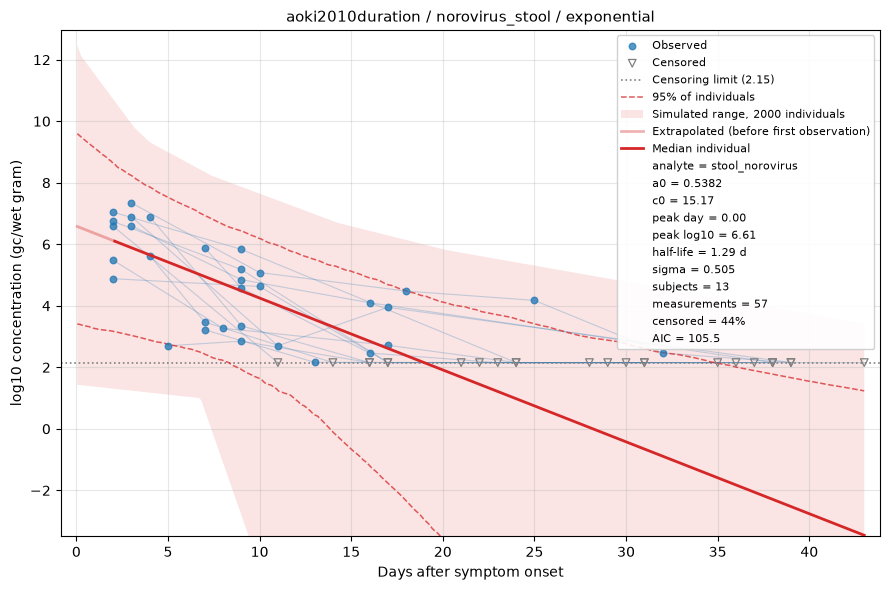
Fitted by censored maximum likelihood. The red line is the median individual; the shaded region is the full range of a simulated cohort drawn from the fitted population, so it shows what simulating from this dataset would produce rather than a confidence interval, with dashed lines at the central 95%. Open triangles are non-detects, drawn at the censoring limit and entering the fit as "below this value" rather than being dropped. See the modelling methods for what these estimates do and do not support.