Epidemiological, clinical and virological characteristics of four cases of monkeypox support transmission through sexual contact, Italy, May 2022 antinori2022epidemiological
Case series of four mpox (MPXV) infections detected in central Italy in May 2022 in adult men who have sex with men. Multiple specimen types (including genital/rectal lesions, nasopharyngeal swab, serum, plasma, scab, stool/faeces, saliva, and seminal fluid) were tested by real-time PCR for MPXV DNA; results are reported as PCR quantification cycle (Cq) values at specific days after symptom onset.
Analytes
genital_or_rectal_lesions
MPXV DNA detection by real-time PCR; results reported as quantification cycle (Cq) values for genital or rectal lesion samples. Screening used Real-Star Orthopoxvirus PCR Kit (Altona); confirmatory PCR was G2R_G assay (Li et al.) targeting TNF receptor gene; run on Rotor-Gene Q after nucleic acid extraction with QIAamp Viral RNA Mini Kit.
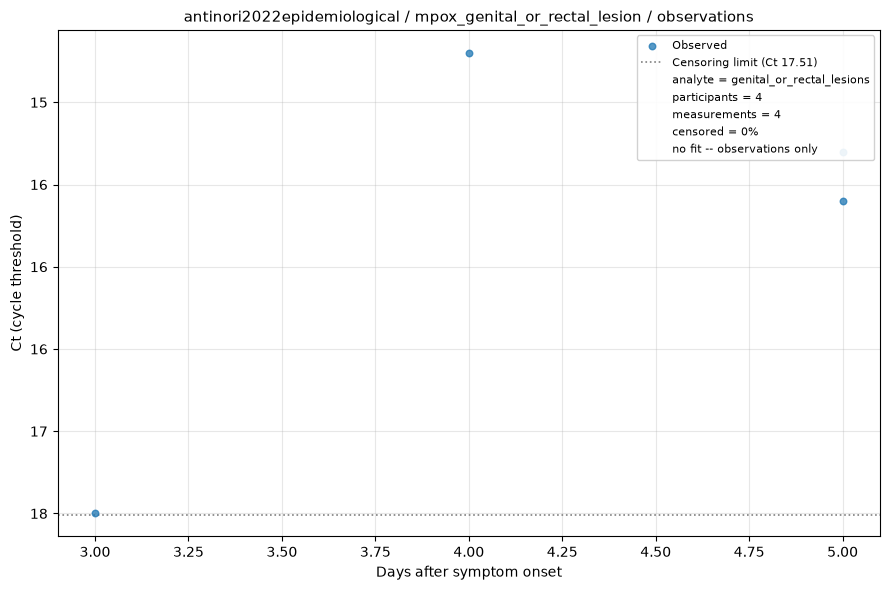
Measurements only — no shedding model is fitted to this analyte, usually because it is sampled once per participant, leaving no trajectory to fit, or because nothing was ever detected. Open triangles are non-detects, drawn at the assay's censoring limit. See the modelling methods for what these estimates do and do not support.
nasopharyngeal_swab
MPXV DNA detection by real-time PCR; results reported as quantification cycle (Cq) values for nasopharyngeal swabs. Screening used Real-Star Orthopoxvirus PCR Kit (Altona); confirmatory PCR was G2R_G assay (Li et al.) targeting TNF receptor gene; run on Rotor-Gene Q after nucleic acid extraction with QIAamp Viral RNA Mini Kit.
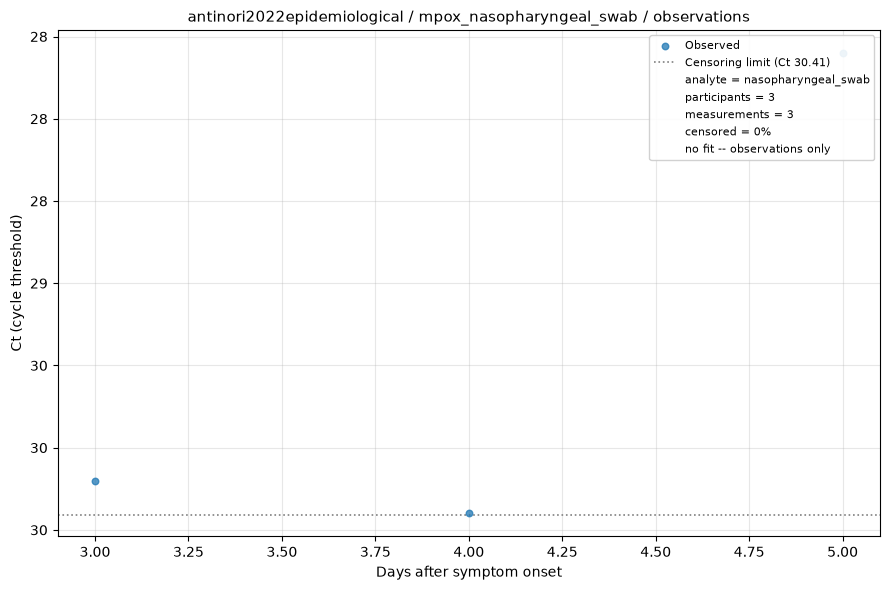
Measurements only — no shedding model is fitted to this analyte, usually because it is sampled once per participant, leaving no trajectory to fit, or because nothing was ever detected. Open triangles are non-detects, drawn at the assay's censoring limit. See the modelling methods for what these estimates do and do not support.
plasma
MPXV DNA detection by real-time PCR; results reported as quantification cycle (Cq) values for plasma. Screening used Real-Star Orthopoxvirus PCR Kit (Altona); confirmatory PCR was G2R_G assay (Li et al.) targeting TNF receptor gene; run on Rotor-Gene Q after nucleic acid extraction with QIAamp Viral RNA Mini Kit.
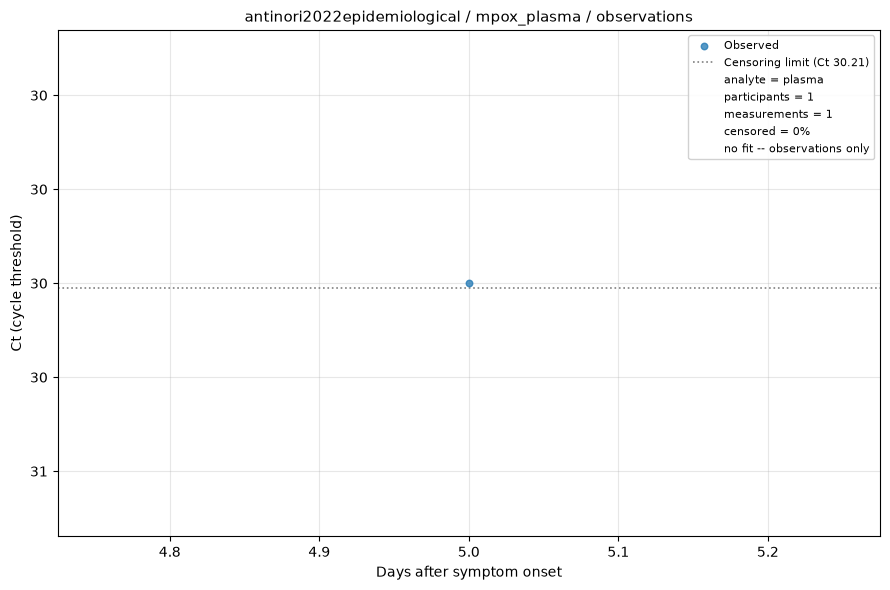
Measurements only — no shedding model is fitted to this analyte, usually because it is sampled once per participant, leaving no trajectory to fit, or because nothing was ever detected. Open triangles are non-detects, drawn at the assay's censoring limit. See the modelling methods for what these estimates do and do not support.
scab
MPXV DNA detection by real-time PCR; results reported as quantification cycle (Cq) values for scab material. Screening used Real-Star Orthopoxvirus PCR Kit (Altona); confirmatory PCR was G2R_G assay (Li et al.) targeting TNF receptor gene; run on Rotor-Gene Q after nucleic acid extraction with QIAamp Viral RNA Mini Kit.
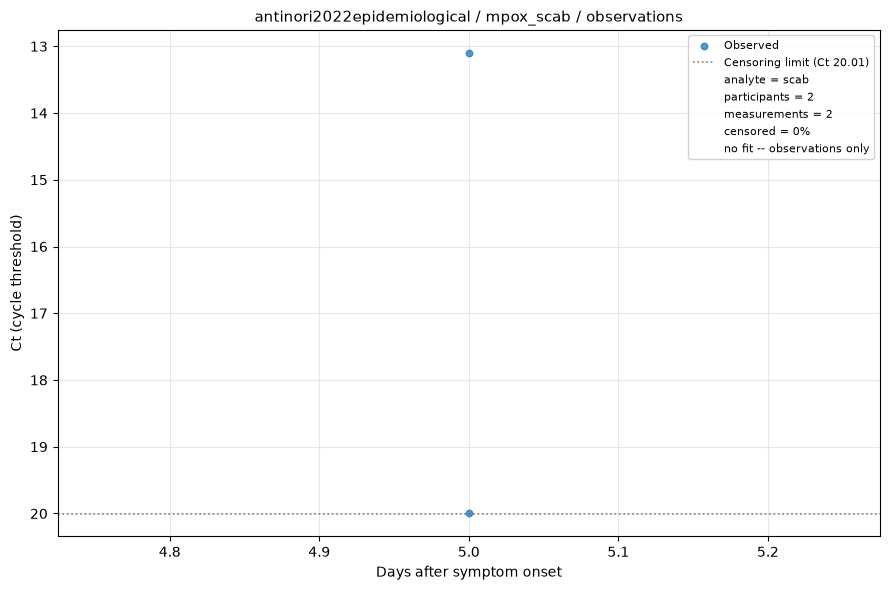
Measurements only — no shedding model is fitted to this analyte, usually because it is sampled once per participant, leaving no trajectory to fit, or because nothing was ever detected. Open triangles are non-detects, drawn at the assay's censoring limit. See the modelling methods for what these estimates do and do not support.
serum
MPXV DNA detection by real-time PCR; results reported as quantification cycle (Cq) values for serum. Screening used Real-Star Orthopoxvirus PCR Kit (Altona); confirmatory PCR was G2R_G assay (Li et al.) targeting TNF receptor gene; run on Rotor-Gene Q after nucleic acid extraction with QIAamp Viral RNA Mini Kit.
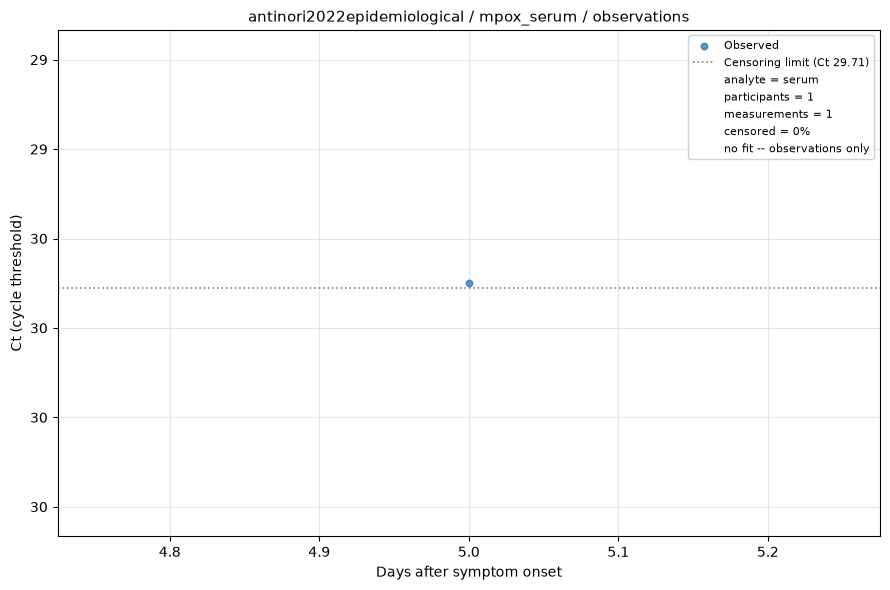
Measurements only — no shedding model is fitted to this analyte, usually because it is sampled once per participant, leaving no trajectory to fit, or because nothing was ever detected. Open triangles are non-detects, drawn at the assay's censoring limit. See the modelling methods for what these estimates do and do not support.
seminal_fluid
MPXV DNA detection by real-time PCR; results reported as quantification cycle (Cq) values for seminal fluid. Screening used Real-Star Orthopoxvirus PCR Kit (Altona); confirmatory PCR was G2R_G assay (Li et al.) targeting TNF receptor gene; run on Rotor-Gene Q after nucleic acid extraction with QIAamp Viral RNA Mini Kit.
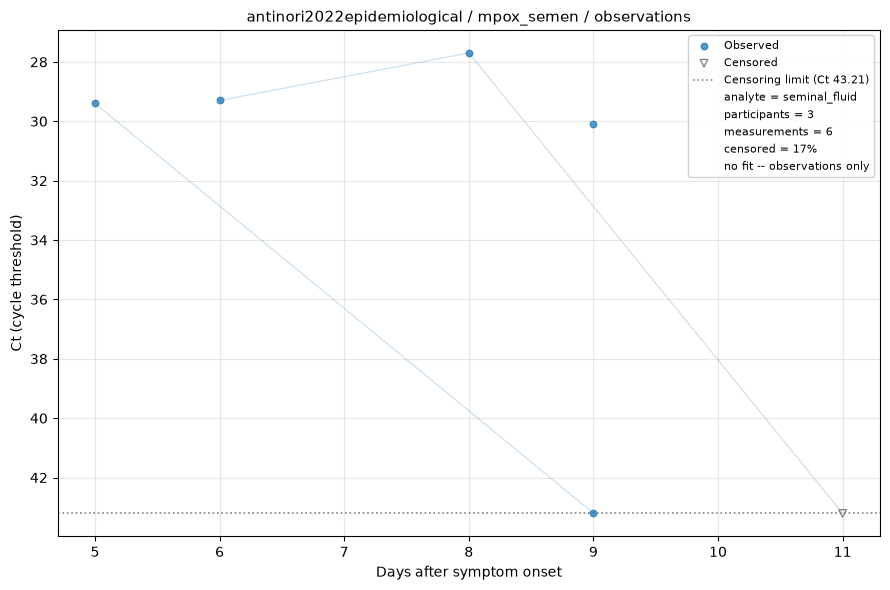
Measurements only — no shedding model is fitted to this analyte, usually because it is sampled once per participant, leaving no trajectory to fit, or because nothing was ever detected. Open triangles are non-detects, drawn at the assay's censoring limit. See the modelling methods for what these estimates do and do not support.
stool
MPXV DNA detection by real-time PCR; results reported as quantification cycle (Cq) values for faeces/stool. Screening used Real-Star Orthopoxvirus PCR Kit (Altona); confirmatory PCR was G2R_G assay (Li et al.) targeting TNF receptor gene; run on Rotor-Gene Q after nucleic acid extraction with QIAamp Viral RNA Mini Kit.
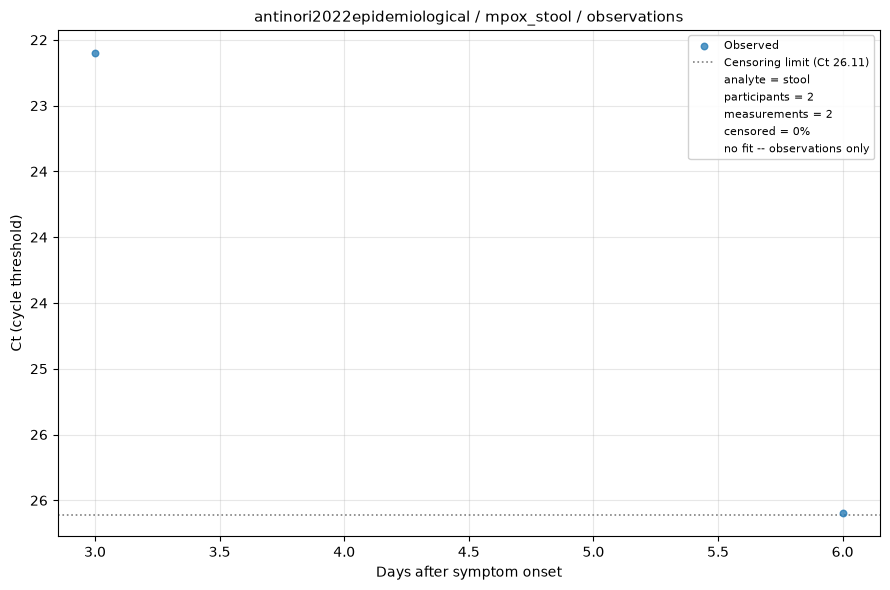
Measurements only — no shedding model is fitted to this analyte, usually because it is sampled once per participant, leaving no trajectory to fit, or because nothing was ever detected. Open triangles are non-detects, drawn at the assay's censoring limit. See the modelling methods for what these estimates do and do not support.
saliva
MPXV DNA detection by real-time PCR; results reported as quantification cycle (Cq) values for saliva. Screening used Real-Star Orthopoxvirus PCR Kit (Altona); confirmatory PCR was G2R_G assay (Li et al.) targeting TNF receptor gene; run on Rotor-Gene Q after nucleic acid extraction with QIAamp Viral RNA Mini Kit.
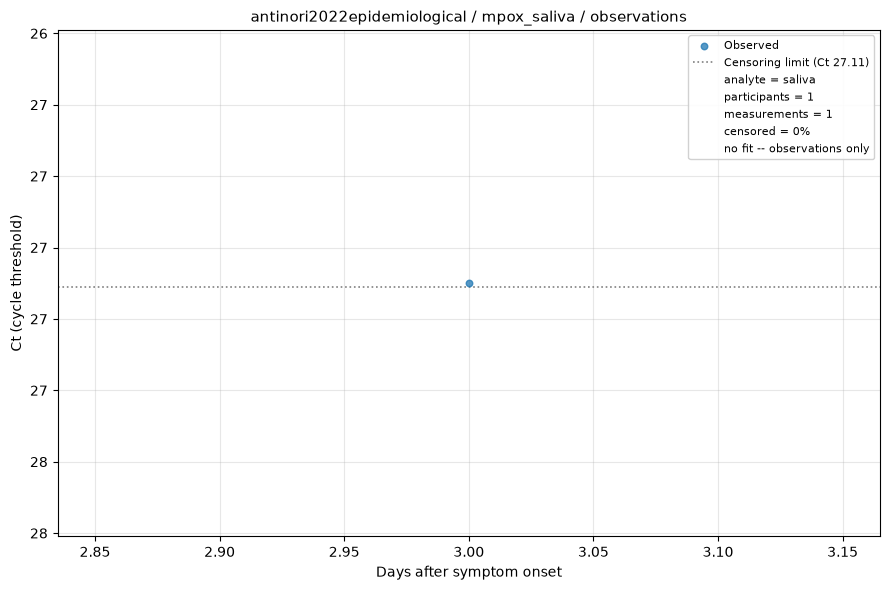
Measurements only — no shedding model is fitted to this analyte, usually because it is sampled once per participant, leaving no trajectory to fit, or because nothing was ever detected. Open triangles are non-detects, drawn at the assay's censoring limit. See the modelling methods for what these estimates do and do not support.
skin_lesions
MPXV DNA detection by real-time PCR; results reported as quantification cycle (Cq) values for skin lesion samples. Screening used Real-Star Orthopoxvirus PCR Kit (Altona); confirmatory PCR was G2R_G assay (Li et al.) targeting TNF receptor gene; run on Rotor-Gene Q after nucleic acid extraction with QIAamp Viral RNA Mini Kit.
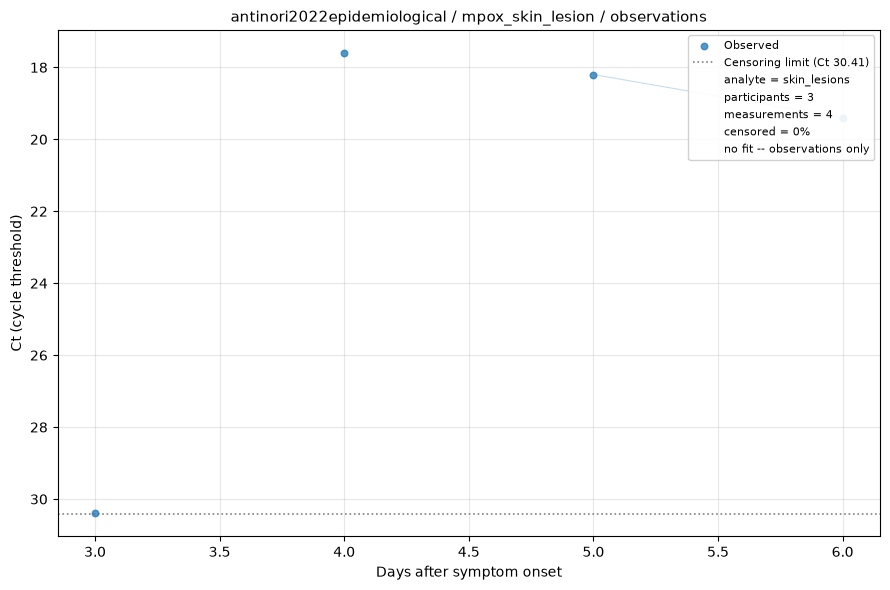
Measurements only — no shedding model is fitted to this analyte, usually because it is sampled once per participant, leaving no trajectory to fit, or because nothing was ever detected. Open triangles are non-detects, drawn at the assay's censoring limit. See the modelling methods for what these estimates do and do not support.