Clinical and virological data of the first cases of COVID-19 in Europe: a case series lescure2020clinical
The authors followed five patients admitted to Bichat-Claude Bernard University Hospital (Paris, France) and Pellegrin University Hospital (Bordeaux, France) and diagnosed with COVID-19 by semi-quantitative RT-PCR on nasopharyngeal swabs. We assessed patterns of clinical disease and viral load from different samples (nasopharyngeal and blood, urine, and stool samples), which were obtained once daily for 3 days from hospital admission, and once every 2 or 3 days until patient discharge. Stool samples only have positive and negative results (currently not included in this data). The data was obtained from Goyal et al. 2020 for the nasopharyngeal swab results in 4 patients.
Analytes
naso_swab_SARSCoV2
SARS-CoV-2 RNA genome copy concentration in nasopharyngeal swab samples. The concentration were quantified in genome copies per swab.
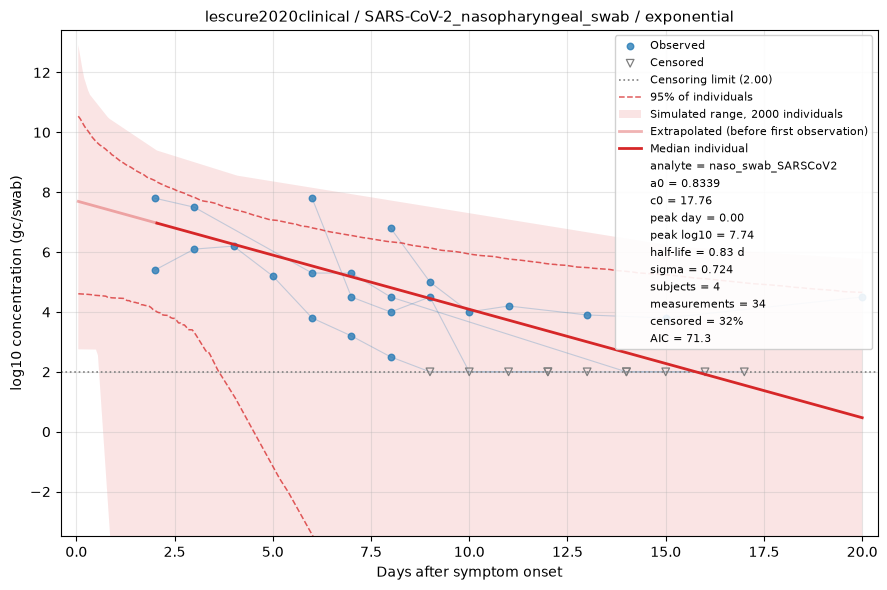
Fitted by censored maximum likelihood. The red line is the median individual; the shaded region is the full range of a simulated cohort drawn from the fitted population, so it shows what simulating from this dataset would produce rather than a confidence interval, with dashed lines at the central 95%. Open triangles are non-detects, drawn at the censoring limit and entering the fit as "below this value" rather than being dropped. See the modelling methods for what these estimates do and do not support.