Quantitative analysis of fecal sapovirus shedding: identification of nucleotide substitutions in the capsid protein during prolonged excretion iwakiri2009quantitative
This study quantifies Sapovirus (SaV) RNA shedding in stool from two outbreak cases using real-time RT-PCR, revealing that SaV excretion generally declines within two weeks but can persist at high concentrations for up to four weeks in some individuals. The study also identifies nucleotide substitutions in the VP1 gene during prolonged excretion, suggesting potential viral evolution.
Analytes
stool_SaV
Sapovirus RNA gene copy concentration in stool samples. The concentration were quantified in cDNA copies per gram.
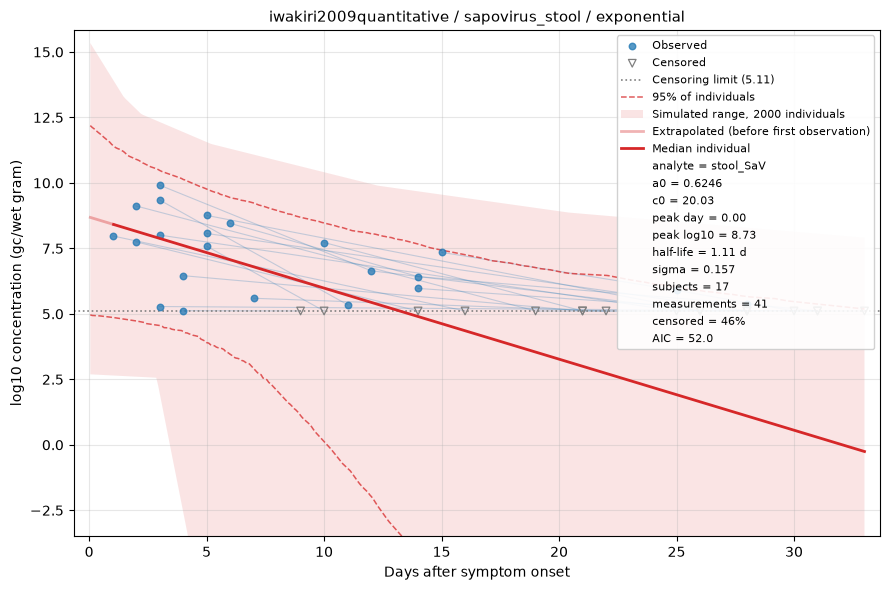
Fitted by censored maximum likelihood. The red line is the median individual; the shaded region is the full range of a simulated cohort drawn from the fitted population, so it shows what simulating from this dataset would produce rather than a confidence interval, with dashed lines at the central 95%. Open triangles are non-detects, drawn at the censoring limit and entering the fit as "below this value" rather than being dropped. See the modelling methods for what these estimates do and do not support.